Glutathione Research: Antioxidant Tripeptide Cell Studies

Last updated: June 2026
A glutathione research peptide is a three-amino-acid molecule made of glycine, cysteine, and glutamate. It is often called GSH. GSH is the main antioxidant inside cells. It neutralizes reactive oxygen species (ROS), chemicals that damage cell parts when they build up. In laboratory models, glutathione has been studied for oxidative stress markers and the Nrf2 gene pathway. Lab teams also study enzyme systems that recycle GSH inside the cell. Data come from cell culture and animal model studies.
Next Level Pharm is a US-based supplier of research-grade Glutathione, verified to ≥99.4% purity by HPLC and mass spectrometry on every batch. Each lot ships with a COA and a lot number for full traceability.
Key Takeaways
- Tripeptide structure: Glutathione (GSH) is made of three amino acids: glycine, cysteine, and glutamate. It is the most abundant intracellular antioxidant. Its synthesis is controlled by the Nrf2 gene pathway.
- Nrf2 pathway: Cell studies show GSH synthesis rises when the Nrf2 pathway is active. Nrf2 is a gene regulator that switches on antioxidant enzyme genes in response to oxidative stress signals.
- ROS neutralization: GSH neutralizes ROS by donating a hydrogen atom from its cysteine group. This converts ROS to water and oxidizes GSH to GSSG. The enzyme glutathione reductase then converts GSSG back to GSH.
- COA-verified lots: Next Level Pharm ships lyophilized Glutathione lots with HPLC and mass spec data on every batch. Each lot has a traceable number.
- Research use only: All Glutathione in this catalog is for laboratory research use only. No clinical outcomes are claimed.
What Is Glutathione and What Does It Do in Cell Models?
GSH is a three-amino-acid molecule that acts as the main intracellular antioxidant. It donates electrons to neutralize ROS and is recycled by glutathione reductase in the cell.
GSH is present in nearly every cell type. Its concentration is highest in the liver, where it reaches 5 to 10 millimolar (mM) levels. In other tissues, GSH sits at 0.5 to 10 mM. It neutralizes ROS by donating a hydrogen atom from the free thiol group on its cysteine residue. This reaction converts the ROS to a less harmful form and turns GSH into oxidized glutathione (GSSG). According to Lu (2013), GSH has four core roles in cell biology: antioxidant defense, detox, immune support, and cell death regulation. Lab teams measure the GSH-to-GSSG ratio as a marker of oxidative stress status in cell cultures. A low ratio shows high oxidative stress.
How Does Nrf2 Control Glutathione Synthesis?
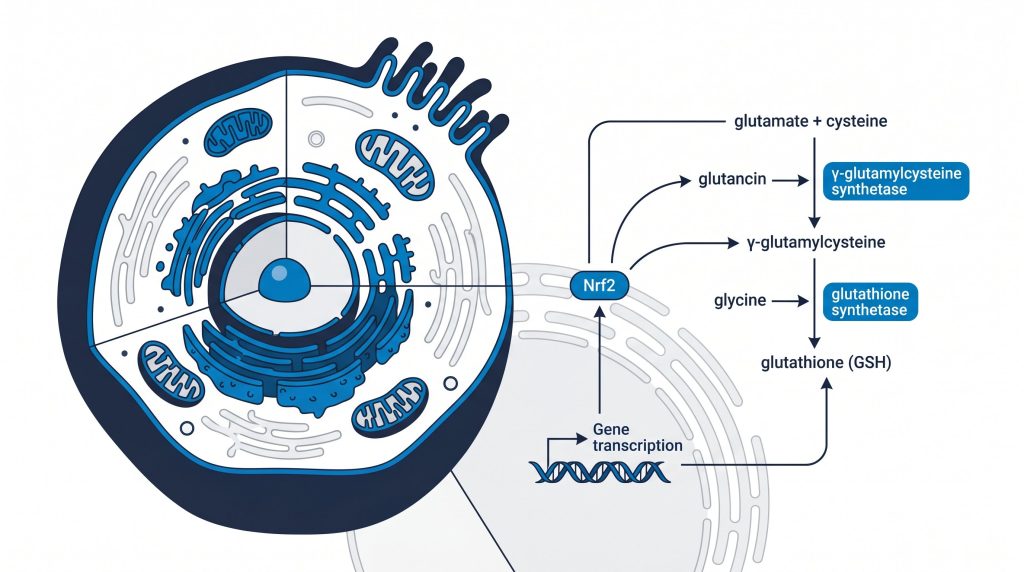
Nrf2 is the main gene switch for GSH synthesis genes. When oxidative stress rises, Nrf2 moves to the cell nucleus and turns on GCLC, GCLM, and GSS genes that build GSH.
Under low-stress conditions, the protein Keap1 holds Nrf2 in the cell fluid and marks it for breakdown. When ROS levels rise, Keap1 changes shape and lets Nrf2 go free. Nrf2 moves to the nucleus and binds a DNA region called ARE (antioxidant response element). This switches on genes for GCLC (glutamate-cysteine ligase catalytic subunit) and GSS (glutathione synthetase). These are the two enzymes that build GSH step by step. According to Aoyama et al. (2021), Nrf2 activation in cell models leads to a measurable rise in intracellular GSH levels within 6 to 24 hours. Lab teams track Nrf2 nuclear entry by western blot and measure GCLC mRNA by RT-PCR.
What Do Cell Studies Show About GSH and Oxidative Stress?
In cell models, low GSH levels are linked to higher ROS. Researchers measure ROS with fluorescent probes and track GSH-to-GSSG ratio by HPLC or colorimetric assay.
Standard cell assay designs induce oxidative stress with a chemical agent such as hydrogen peroxide (H2O2), then measure ROS with a probe like DCFH-DA. When GSH is added before the stress, ROS levels stay lower in treated cells compared to vehicle controls. Researchers also measure lipid peroxidation markers such as MDA (malondialdehyde) and 4-HNE. These markers rise when ROS damage cell membrane lipids. According to Forman et al. (2009), GSH acts as a direct signal molecule in cell redox regulation, not just a passive antioxidant buffer. This makes intracellular GSH level a relevant marker in cell studies of oxidative stress models.

How Does GSH Compare to Other Antioxidant Markers?
GSH, catalase, and superoxide dismutase (SOD) are the three main intracellular antioxidant markers. GSH is the most abundant. Each has a different ROS target and cell location.
Cell antioxidant research often measures GSH alongside SOD and catalase. SOD converts superoxide radicals to hydrogen peroxide. Catalase then breaks H2O2 into water and oxygen. GSH handles a broader set of ROS and also supports the glutaredoxin and peroxiredoxin systems inside the cell. Measuring all three gives a full picture of antioxidant enzyme capacity.
| Antioxidant | Location | Main ROS Target | Measurement |
| GSH | Cytoplasm, mitochondria | Broad ROS spectrum | GSH/GSSG ratio by HPLC |
| SOD | Cytoplasm, mitochondria | Superoxide radical | SOD activity assay |
| Catalase | Peroxisome | Hydrogen peroxide | Catalase activity assay |
What Biomarkers Are Measured in Glutathione Cell Research?
Key markers include GSH/GSSG ratio, GCLC mRNA, Nrf2 nuclear entry, ROS level by DCFH-DA assay, and lipid peroxidation by MDA. Each gives a different view of cell redox status.
GSH/GSSG ratio is the primary output marker in redox cell studies. A ratio above 100:1 shows a healthy redox state in most cell types. To measure it, researchers lyse cells, separate GSH and GSSG by HPLC, and compare peak areas. GCLC mRNA is measured by RT-PCR to track GSH synthesis gene output. Nrf2 nuclear entry is confirmed by western blot on nuclear and cytoplasmic fractions. ROS levels are measured with DCFH-DA fluorescence in live cells. MDA is measured by TBARS assay in cell lysate. Together, these five markers give a complete picture of the GSH system response in cell models.
What Research Tools Are Available for Glutathione Studies?
Lab teams need COA-verified GSH, a GSH/GSSG ratio kit, DCFH-DA ROS probe, Nrf2 antibody, and GCLC/GSS RT-PCR primers.
Research teams need a verified Glutathione lot to run any study. The lot must match the published reference standard for molecular weight and purity. Next Level Pharm verifies each Glutathione lot by HPLC and mass spectrometry before shipping. Commercial GSH/GSSG ratio kits from laboratory suppliers use a recycling assay with glutathione reductase. Teams confirm kit sensitivity before comparing across treatment groups. View the Glutathione product page for lot-specific COA and mass spec data.
Frequently Asked Questions
What is glutathione in research?
Glutathione (GSH) is a three-amino-acid antioxidant molecule studied in cell models for its roles in ROS neutralization, Nrf2 gene pathway activation, and redox balance. Published data come from cell culture and animal model studies. Research-grade GSH is used in oxidative stress assays. This product is for laboratory research use only.
What does the GSH-to-GSSG ratio measure?
The GSH-to-GSSG ratio is a marker of cell redox status. A high ratio (above 100:1 in healthy cells) shows low oxidative stress. When ROS rise, GSH is oxidized to GSSG and the ratio drops. Researchers measure this ratio by HPLC or colorimetric assay. It is one of the most common output markers in antioxidant cell studies.
What is the Nrf2 pathway and how does it relate to GSH?
Nrf2 is a gene regulator that controls GSH synthesis. Under high oxidative stress, Nrf2 is released from its inhibitor Keap1 and moves to the cell nucleus. There it switches on GCLC and GSS genes that build GSH. Lab teams track Nrf2 nuclear entry by western blot and measure GCLC mRNA by RT-PCR to confirm GSH synthesis pathway activation.
What cell lines are used in glutathione research?
Common cell lines include HepG2 (liver), HeLa, and primary astrocytes. HepG2 cells are widely used because the liver has the highest GSH concentration in the body. Researchers choose cell lines based on the tissue being modeled. Each cell line has a published baseline GSH level for comparison. This helps teams detect treatment-related changes accurately.
How is ROS measured in glutathione assays?
ROS is measured with the fluorescent probe DCFH-DA (dichlorodihydrofluorescein diacetate). It enters cells and is converted to a fluorescent compound by intracellular ROS. Fluorescence intensity is read by plate reader or flow cytometer. A lower fluorescence reading in GSH-treated cells shows reduced ROS load compared to vehicle controls.
What is MDA and why is it measured?
MDA (malondialdehyde) is a product of lipid peroxidation. When ROS attack cell membrane lipids, MDA is released into the cell fluid. High MDA shows that ROS damage reached the membrane layer. Researchers measure MDA by TBARS (thiobarbituric acid reactive substances) assay in cell lysates. Lower MDA in treated cells shows reduced ROS-driven membrane damage.
How should glutathione be stored for research?
Lyophilized research-grade glutathione should be stored at -20°C in a sealed container away from light. Reconstituted solutions should be kept at 4°C and used within 24 to 48 hours. GSH oxidizes to GSSG in solution over time, reducing its activity in redox assays. This product ships as a dry powder stable at room temperature during transit.
What published research covers glutathione in cell models?
Lu (2013) in Biochimica et Biophysica Acta covers GSH metabolism and its four biological roles in cells (PMID 23461663). Aoyama et al. (2021) reviews Nrf2 activation and GSH synthesis in oxidative stress models (PMID 34084050). Forman et al. (2009) covers GSH as a signaling molecule in cell redox regulation (PMID 19375517).
What purity standards apply to research-grade glutathione?
Research-grade glutathione must be verified to ≥99% purity by HPLC and mass spectrometry before shipping. Each lot must carry a COA with lot number, purity value, and molecular weight confirmation. Teams confirm lot identity against the published molecular weight of GSH (307.32 g/mol) before starting any oxidative stress cell assay.
How does glutathione relate to the glutaredoxin system?
Glutaredoxins (Grx) are small enzymes that use GSH to reduce disulfide bonds in target proteins. They are part of the broader GSH antioxidant network inside the cell. When GSH is low, glutaredoxin activity drops and protein disulfide damage rises. Lab teams measure Grx activity alongside GSH/GSSG ratio in cell studies of redox enzyme systems.
Summary
Glutathione (GSH) is a three-amino-acid antioxidant studied in cell models for ROS neutralization and Nrf2 pathway activation. Its GSH-to-GSSG ratio is the standard output marker in redox biology assays. Data from Lu (2013), Aoyama et al. (2021), and Forman et al. (2009) support its use as a reference compound.
Lab teams use GSH to study the Nrf2 gene switch, GCLC synthesis enzyme, and lipid peroxidation markers in HepG2 and primary cell cultures. All results come from in vitro models and do not represent clinical outcomes.
What Should You Do Next?
- Confirm your cell line’s baseline GSH level before ordering research-grade glutathione lots.
- Review DCFH-DA ROS assay protocols in published oxidative stress literature before setting up your study.
- Check COA data for lot-specific purity and molecular weight on the Glutathione product page.
- Pair GSH data with SOD and catalase measurements for a full antioxidant enzyme profile.
- Browse beauty research peptides for related research tools.
- Shop research peptides at https://nextlevelpharm.com/shop/.
People Also Read
- GHK-Cu Research: Copper Peptide and Skin Biology Studies
- NAD+ Research: Nicotinamide Adenine Dinucleotide Cell Studies
About the Author
Next Level Pharm Research Team
Alex M covers peer-reviewed findings in peptide science for Next Level Pharm, a US-based supplier of research-grade peptides verified to ≥99% purity via HPLC and mass spectrometry on every batch.
Disclaimer: The information provided on this page is for educational and research purposes only. Next Level Pharm products are intended for laboratory research use only. They are not intended for human consumption, diagnostic, therapeutic, or medicinal purposes. This content does not constitute medical advice. Always consult a licensed healthcare professional before making any health-related decisions.