What Are Amino Acids? Building Blocks of Peptide Research

Last updated: June 2026
An amino acid is an organic molecule. It serves as the building block of peptides and proteins. All 20 standard amino acids share the same core structure. Each has an alpha carbon. It links to an amino group, a carboxyl group, a hydrogen atom, and a variable side chain. The side chain sets each amino acid’s chemical traits. Peptides are chains of amino acids linked by peptide bonds. The sequence of amino acids in a chain sets its structure and function in research models.
Next Level Pharm is a US supplier of research-grade peptides. Every peptide batch is tested by HPLC and mass spec to verify identity and purity. The average purity across the last 100 batches is 99.4%. The amino acid sequence is confirmed by mass spec on every lot. Researchers can view the COA for each batch before purchase.
Understanding amino acids is a foundation for peptide research. Each peptide is defined by the number, type, and order of its amino acids. Small sequence changes can alter receptor binding and half-life. They also affect peptide behavior in cell models.
Key Takeaways
- Amino Acids Are the Units of Peptides: Each one has an amino group, a carboxyl group, and a variable side chain. The side chain defines its chemical role in a chain.
- Peptide Bonds Link Amino Acids Together: A peptide bond forms when the carboxyl of one amino acid joins the amino group of the next. Water is released in this reaction.
- Sequence Sets Peptide Function: The order of amino acids in a chain sets how it folds and what it binds. Even one change in sequence can alter receptor affinity.
- Essential Amino Acids Cannot Be Made by the Body: Nine of the 20 standard amino acids must come from outside the body. These are used in research as separate compounds or as part of peptide sequences.
- Mass Spec Confirms Amino Acid Sequence in Research: Mass spectrometry reads the molecular weight of a peptide and can confirm its amino acid composition. This is a standard step in peptide quality control.
The amino acid sequence of a peptide is its primary structure. This sequence drives higher-order structure. It also sets how the peptide is used in cell and animal research models.
What Are Amino Acids?
Amino acids are molecules with four key parts. The central alpha carbon has four parts. It links to an amino group (-NH2), a carboxyl group (-COOH), a hydrogen atom, and an R group (side chain). The R group is the only part that differs between amino acids. It can be a simple hydrogen atom (glycine) or a large ring (tryptophan).
The R group’s chemistry defines how each amino acid behaves in a chain. Nonpolar side chains repel water. Polar side chains attract water. Charged side chains form ionic bonds in protein structures. These properties control how a peptide folds and what it binds in cell models.
According to a review in Nature Protocols (2015), amino acid side chain chemistry links to receptor binding affinity in cell models. Studies have shown that single amino acid substitutions can alter receptor binding by orders of magnitude. These are cell model findings.
How Do Amino Acids Link to Form Peptides?
Amino acids join through peptide bonds. A peptide bond links two amino acids. The carboxyl group (-COOH) of one joins the amino group (-NH2) of the next. A water molecule is released in this reaction. The resulting bond is a covalent C-N link called a peptide bond.
The chain that forms has two ends. The amino end is called the N-terminus. The carboxyl end is called the C-terminus. Peptide sequences are written from N-terminus to C-terminus by convention. A chain of two amino acids is a dipeptide. A chain of three is a tripeptide. Longer chains (over ten amino acids) are called polypeptides.
According to a review in Amino Acids (2018), peptide chains always run N to C. This holds for both biology and lab synthesis. Synthetic peptide synthesis (SPPS) mirrors this direction and uses it to build any target sequence. These are core biochemistry findings.
What Are the 20 Standard Amino Acids?
The 20 standard amino acids are the building blocks of all natural proteins. They also form most research peptides. They are divided into groups by side chain chemistry. Nonpolar amino acids include glycine, alanine, leucine, and valine. Polar amino acids include serine, threonine, and glutamine. Charged amino acids include lysine, arginine, aspartate, and glutamate.
Nine of the 20 are essential. The body cannot make them, so they must come from outside sources. The essential amino acids are histidine, isoleucine, leucine, lysine, methionine, phenylalanine, threonine, tryptophan, and valine. In research, individual amino acids serve as HPLC standards or as parts of synthetic peptide sequences.
How Does Sequence Affect Peptide Function?
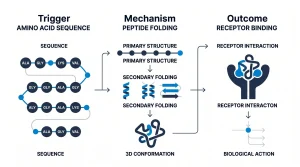
The sequence of amino acids in a peptide is its primary structure. This sequence sets how the peptide folds in solution. Alpha helices and beta sheets form through hydrogen bonds between backbone atoms. The 3D shape is the final folded form of the peptide.
In research, sequence is everything. Two peptides that differ by one amino acid can have completely different receptor binding profiles. Researchers use sequence data to explain why one analog binds more tightly than another. Mass spec and HPLC together confirm that the synthesized sequence matches the target.
| Amino Acid Group | Examples | Side Chain Property | Research Role |
| Nonpolar | Glycine, Alanine, Leucine | Hydrophobic | Core of folded peptide |
| Polar | Serine, Threonine, Cysteine | Hydrophilic | Surface interactions |
| Positively charged | Lysine, Arginine, Histidine | Cationic | Receptor binding sites |
| Negatively charged | Aspartate, Glutamate | Anionic | Ionic binding and structure |
| Aromatic | Tyrosine, Tryptophan, Phenylalanine | Mixed | Pi-stacking and signaling |
What Are Essential Amino Acids in Research?
Essential amino acids are those the body cannot make on its own. In research, they are used as reference standards in amino acid analysis. They are also building blocks in synthetic peptide sequences. Lysine and arginine, for example, are common attachment points for fatty acid changes in GLP-1 analogs. Methionine is a methyl donor and a key residue in lipotropic compound research.
Researchers also study changes of essential amino acids. Methylated histidine, acetylated lysine, and phosphorylated serine are all examples of post-translational changes studied in cell models. These chemical changes to amino acids alter how a peptide behaves in a cell.
How Are Amino Acids Tested in Peptide Research?
Amino acid composition is confirmed by two methods in peptide quality control. First, mass spectrometry measures the total molecular weight and can identify each amino acid from fragmentation patterns. Second, HPLC resolves the peptide from impurities and confirms purity as a percentage of peak area.
Together, mass spec and HPLC confirm the correct sequence. They also verify that purity is at ≥99%. A COA lists both results for each batch. Shop research peptides at Next Level Pharm with full COA data for every batch.
According to a study in Molecules (2019), HPLC and mass spectrometry are the standard tools for peptide identity and purity confirmation. Both are required for research-grade lot verification. Combining both methods provides the most complete picture of peptide composition. These are analytical standards from the published research community.
Frequently Asked Questions
What Is an Amino Acid?
An amino acid has four key parts. These are an amino group, a carboxyl group, a hydrogen atom, and an R group (side chain). The alpha carbon holds all four together. The R group sets the amino acid’s chemical properties. There are 20 standard amino acids used in all natural proteins and most synthetic research peptides.
How Many Types of Amino Acids Are There?
There are 20 standard amino acids used in natural protein synthesis. Nine of these are essential. The body cannot make them and must obtain them from outside sources. In peptide research, non-standard amino acids and chemical changes are also used to create analogs with altered properties such as DPP-4 resistance or extended half-life.
What Is a Peptide Bond?
A peptide bond is a covalent C-N bond that links two amino acids together. It forms between the carboxyl group of one amino acid and the amino group of the next, with water released. This bond-forming step is how all peptide chains are built, both in biology and in solid-phase peptide synthesis used to make research-grade peptides.
How Does the Amino Acid Sequence Affect Function?
The sequence of amino acids in a peptide sets its primary structure, which drives its folding, receptor binding, and stability. Even a single amino acid change can alter receptor affinity or half-life. In GLP-1 analogs, for example, a single substitution at position 8 or 34 changes DPP-4 resistance and plasma half-life in animal models.
What Are Essential Amino Acids?
Essential amino acids are the nine that the body cannot synthesize: histidine, isoleucine, leucine, lysine, methionine, phenylalanine, threonine, tryptophan, and valine. In peptide research, these are key reference compounds and common attachment points for chemical changes. Lysine and methionine are especially common change sites in GLP-1 and lipotropic analog research.
What Is an N-Terminus and C-Terminus?
The N-terminus is the amino end of a peptide chain, where the first amino group is free. The C-terminus is the carboxyl end, where the last carboxyl group is free. Peptide sequences are written from N-terminus to C-terminus by convention. Changes at these ends, such as amidation at the C-terminus or acetylation at the N-terminus, are common in research analog design.
How Are Amino Acids Analyzed in Research?
Amino acids in a peptide are confirmed by mass spec and HPLC. Mass spec reads molecular weight and fragment patterns. HPLC separates and quantifies each compound in the batch. Together, these methods confirm the correct sequence is present at ≥99% purity. Both results appear on the COA that ships with each research-grade peptide batch.
What Is a Dipeptide vs. a Polypeptide?
A dipeptide is a chain of exactly two amino acids linked by one peptide bond. A tripeptide has three. A polypeptide has more than ten amino acids. Most research peptides are between 2 and 50 amino acids long. Larger chains (over 50 amino acids) are generally called proteins, though the boundary is not strict in research literature.
How Are Amino Acids Used in Peptide Synthesis?
In solid-phase peptide synthesis (SPPS), amino acids are added one at a time to a growing chain that is anchored to a resin. Each amino acid is protected to control which end reacts. After the sequence is complete, the chain is released and purified by HPLC. Mass spec confirms the final product matches the target sequence.
Summary
Amino acids are the organic building blocks of all peptides. Their sequence sets how a peptide folds, what it binds, and how it behaves in research models. The 20 standard amino acids can be linked in any order to produce synthetic peptides with specific research properties.
Mass spec and HPLC together confirm the sequence and purity of every research-grade peptide batch. These tools are the foundation of peptide quality control in lab research.
What Should You Do Next?
Researchers sourcing peptides should verify mass spec identity and HPLC purity on the COA before any study use. The amino acid sequence and purity result should both be present for the lot number on record.
Shop research peptides at Next Level Pharm. Every batch is tested by HPLC and mass spec with a COA on every order.
People Also Read
- What Is a Peptide? Building Blocks and Research Applications
- Peptide Synthesis Explained: How Research-Grade Peptides Are Made
About the Author
Next Level Pharm Research Team
Alex M covers peer-reviewed findings in peptide science for Next Level Pharm, a US-based supplier of research-grade peptides verified to ≥99% purity via HPLC and mass spectrometry on every batch.
Disclaimer: The information provided on this page is for educational and research purposes only. Next Level Pharm products are intended for lab research use only. They are not intended for human consumption, diagnostic, therapeutic, or medicinal purposes. This content does not constitute medical advice. Always consult a licensed healthcare professional before making any health-related decisions.