
Statistical Power in Peptide Research Design

Statistical Power in Peptide Research Design
Last updated: September 2026
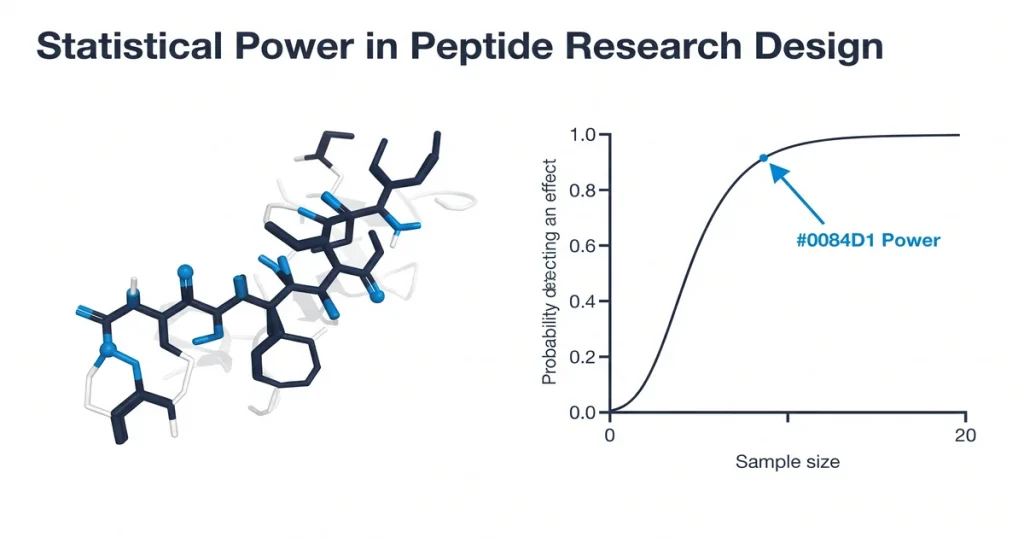
Statistical power is the probability that a research study detects a true effect. One exists, preventing Type II errors. Type II errors occur. Researchers fail to find a statistically major result despite a real effect. This concept relies on sample size, effect size. Alpha levels to find the response of an experiment. High power ensures. Results are more likely to represent cell reality rather than random chance. Researchers use power test to calculate the minimum group size for accurate findings.
Next Level Pharm offers high-grade research items with 99.4% average purity across its last 100 batches. The brand ensures quality through rigorous HPLC and mass spectrometry testing on each vial. All research compounds remain lyophilized to keep stability at room temperature. Eliminating the need for cold chain logistics. These processes give a stable baseline for labs across the United States.
Accurate research design needs attention to these lab factors, ensuring the validity of data outputs. Labs focusing on peptide research often rely on standardized purity markers, controlling for confounding factors in their trials. This approach to item sourcing minimizes the risk of false conclusions during test test. Steady test methods allow for comparisons across different test trials and settings.
Key Takeaways
- Defining Statistical Power: Statistical power is the probability of a study detecting a real. Existing research effect. It assists researchers in avoiding the mistake of a false negative conclusion.
- The 80% standard: Research often uses 80% power as a standard convention for test design. This value gives a balance between detecting true effects and managing limited resources.
- Interplay of Factors: Four factors find power levels within any given peptide research study. These are sample size, effect size, the chosen alpha level, and the desired power.
- Effect Size Dynamics: A larger effect from a peptide allows for smaller sample sizes in the study. Small effects need more subjects to achieve the same level of statistical confidence.
- Risks of Low Power: Studies with low power risk missing true discoveries. Wasting time and resources. Such designs can also add to a lack of reproducibility in science.
The following sections give a more detailed look at the mechanics of test design. The role of power test. Understanding these factors allows researchers to build plans that produce solid and verifiable data.
What is statistical power in simple terms?
Statistical power represents the probability of a study correctly identifying a real effect if one truly exists. It functions like a microscope’s power to focus on a specimen. Is actually present in the sample. High power increases the chance. A researcher will see a genuine signal amidst the backgr, according to PubMed (2023), rigorous peptide characterization includes mass verification and purity confirmation for accurate lab results.ound noise of an experiment. Low power makes it difficult to distinguish a true, subtle result from random change.
When power is low, the probability of detection drops greatly. This increases the risk of a Type II error. Is a false negative. In this scenario, the data fails to show an effect that is actually there. Researchers contrast this with a Type I error, or a false positive. They report an effect that is not real. The alpha level sets the threshold for those false positives. Balancing these errors is key for valid, sound data.
BPC-157 is ready as a COA-checked research peptide. Each lot is checked by HPLC and mass spec.
Why is 80% power a common research standard?
Eighty percent power serves as a standard in resear, according to PubMed (2017), standardized analytical protocols are key for reproducible peptide research outcomes.ch. Balance the need for accuracy against the limits of study resources. This convention, formalized by researcher Jacob Cohen, helps staff choose a sample size. Avoids false negatives. Keeping the project scope realistic. By setting power at 80 percent, researchers intentionally accept a beta (β) level of 0.20. Is the probability of failing to detect a true effect.
This decision represents an acceptable risk-to-resource ratio for most lab model and trial studies. Increasing power beyond 80 percent needs a larger sample size. Increases the time and items needed for the study. Many researchers find this trade-off enough for identifying major signals in cell data. CJC-1295 is ready as a COA-checked research peptide. Each lot is checked by HPLC and mass spec, maintaining this standard allows for efficient exploration. Minimizing the chance of missing valid, small-scale results.
What four factors influence statistical power?
Statistical power is found by four primary factor, according to NCBI (2022), peptide purity and structural integrity are critical quality markers in research settings.s: sample size (n). Effect size, the alpha level (α). The desired power level itself. Researchers use a power test to calculate the probability. A study will correctly detect a true effect. One exists. An increase in sample size (n) boosts the power to find an effect. Narrows the margin for error. Similarly, a larger effect size makes it easier for statistical tests. Distinguish a signal from background noise. These factors function as a system of balances during study design.
Adjusting the alpha level (α) also shifts the power threshold. A stricter alpha level, such as 0.01 compared to the standard 0.05. Reduces the risk of a false positive. It also lowers overall power. Researchers must expand the sample size (n). Compensate for this shift if they wish to keep high response. BPC-157 is ready as a COA-checked research peptide. Each lot is checked by HPLC and mass spec, maintaining this balance ensures. Studies remain valid according to established scientific frameworks often discussed in the Journal of Peptide Science.
How does effect size impact peptide studies?
Effect size describes the magnitude of the difference found in a research study between test groups. In peptide research. This value represents the change in a set marker after subjects receive a compound. A large effect size shows a strong signal between the factor and the outcome. Conversely, a small effect size suggests a subtle difference. May be harder to detect statistically. A clinically meaningful difference needs that the observation has practical value beyond raw numbers.
Peptides expected to produce a large effect size need a smaller sample size, achieving enough statistical power. When a peptide shows a small effect size. Researchers must increase the number of participants to confirm the findings. Next Level Pharm gives compounds for precise investigative work. BPC-157 is ready as a COA-checked research peptide. Each lot is checked by HPLC and mass spec. Accurate calculation ensures studies avoid type two errors.
How is sample size calculated for peptide research?
An a priori power test finds the minimum sample size by calculating the statistical power needed. Detect an effect before a study begins. Researchers define the desired power, often set at 80 percent. Alongside an alpha level of 0.05. These values allow for the calculation of the set group size needed to avoid a type two error. Using G*Power software. The team inputs these constraints along with an estimated effect size based on prior literature. This formal process ensures that the study remains adequately powered to see true differences in the collected data.
The software generates a result that signifies the minimum sample size for each group. Proper planning limits underpowered trials that fail to yield meaningful findings. Next Level Pharm gives high-purity compounds to support these test designs. Tirzepatide is ready as a COA-checked research peptide. Each lot is checked by HPLC and mass spec. This approach keeps the health of the data. Ensuring each study adheres to high standards.
What are the risks of underpowered studies?
The primary risk of an underpowered study is producing a false negative result. A real effect is missed due to a sample size that is too small. When a study lacks enough statistical power, the power to confirm a true signal is compromised.
This limitation carries heavy costs for the scientific community, including wasted resources like time, funding. Lab items. Underpowered research also creates an unethical burden. It often involves the use of animal subjects without the capacity. Yield valid data. These flaws add to a growing replicability crisis. Findings cannot be checked across separate lab settings. Additionally, these studies promote publication bias. Journals favor positive findings while negative or inconclusive results are often ignored.
BPC-157 is ready as a COA-checked research peptide. Each lot is checked by HPLC and mass spec. This ensures that researchers have high-quality, stable items for their work.
Frequently Asked Questions
Is 80% statistical power good?
An 80% power level is considered a standard standard in test research. It shows an 80% probability. A study will correctly find an effect if one is present. While higher power offers greater certainty, 80% serves as a practical compromise between research accuracy. Resource allocation.
What does 90% statistical power mean?
A 90% statistical power means the experiment has a 90% chance of detecting a true effect. It exists. This higher threshold reduces the probability of a Type II error. False negative, to 10%. Researchers choose this level. They want to minimize the risk of missing a meaningful discovery. While it gives more confidence than the 80% standard, it needs a larger sample size to achieve. Increases the total resources needed for the experiment.
What is statistical power in research?
Statistical power refers to the probability. A statistical test will reject a false null hypothesis. It is essentially the response of the experiment to detect a real, non-random effect. If a study lacks adequate power, it cannot well differentiate between a true cell signal. Random noise in the gathered data.
Why use g * power to calculate sample size?
G*Power is a specialized tool that simplifies the complex math needed for power test. It allows researchers to calculate the sample size needed. Detect an effect based on their chosen alpha. Power levels. By using this software, researchers avoid manual errors that can compromise study health. It gives a standardized approach to find the correct number of subjects. Ensures. The study remains capable of producing valid, repeatable results under various test settings.
What is the difference between p-value and power?
A p-value is calculated after the experiment ends to find if the found result is statistically major. In contrast, power is calculated before the experiment begins as a design factor. The p-value tells you the probability that the data occurred by random chance. Power tells you the probability. Your study design is capable of finding an effect. Both metrics are needed to confirm. Research conclusions have a strong basis in objective, measurable data.
Can statistical power be over 100%?
Statistical power is a probability. Means it is bounded by a maximum of 100%. In practice, power represents the likelihood of success. It can never exceed this limit. While a study can be designed to reach very high levels of power, such as 99%, the goal is to find the most efficient sample size. Meets the research objectives. Seeking a power of 100% is not possible. Is usually not needed for producing clear, major data.
What is an example of statistical power in a study?
Consider a study designed to test if a peptide affects a set marker. If the researchers have 80% power, they have an 80% chance of observing a major change if the peptide truly impacts. Marker. If the study only had 50% power, they would be as likely to miss the effect as they would be to see it.
How do you increase statistical power in a study?
Researchers increase power mainly by increasing the sample size of the study. A larger group of subjects gives more data. Makes it easier for statistical tests to find true effects. Other ways to boost power include increasing the alpha level. Though this also raises the risk of false positives.
What Should You Do Next?
Review your project scope and assess. Research peptides align with your set study requirements. Test. Your lab setting supports the storage of lyophilized compounds at room temperature before you start your next series of trials. You may request set lab records or certificates of test to ensure. Each sample meets your study criteria for high-purity research items.
Researchers sourcing peptides for test study can explore the full inventory of COA-checked items at Shop.
People Also Read
- What Makes a Peptide Research Grade? Standards and Testing Explained
- BPC-157 vs TB-500: A Detailed Research contrast Guide
About the Author
Author Block
Next Level Pharm Research Team
The Next Level Pharm research team is composed of biochemists and lab scientists dedicated to providing researchers with the highest-purity, COA-verified research peptides available. Every batch is HPLC and mass spec verified before dispatch.
Disclaimer: The information provided on this page is for educational and research purposes only. Next Level Pharm products are intended for lab research use only. They are not intended for human consumption, diagnostic, therapeutic, or medicinal purposes. This content does not constitute medical advice. Always consult a licensed healthcare professional before making any health-related decisions.