
Brain Peptides Compared: Semax vs Selank vs PE-22-28

Last updated: May 2026
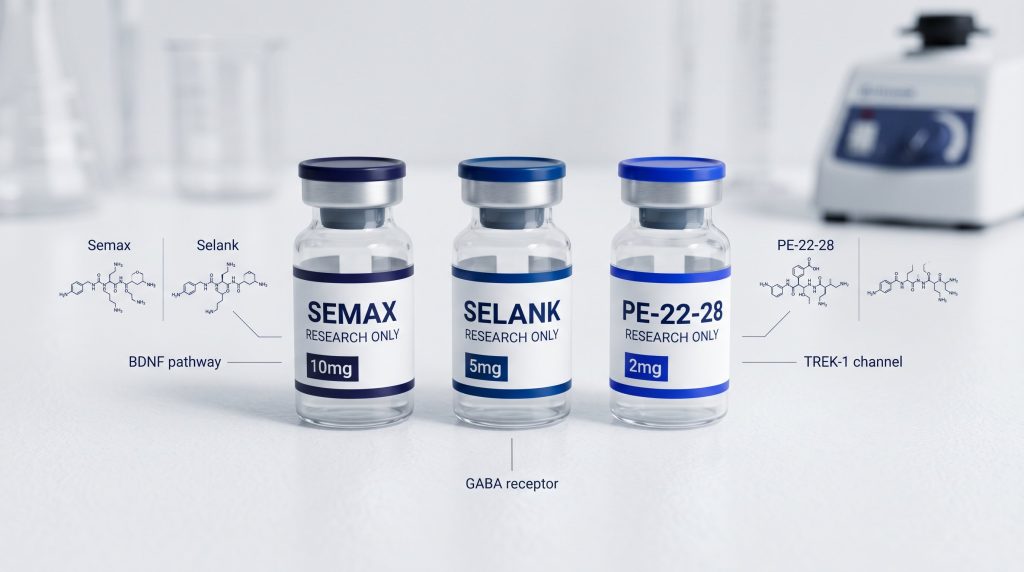
A brain peptides review looks at how neuropeptides act in lab models. These are short-chain amino acid sequences studied for effects on neural systems. Research on synthetic neuropeptides has grown over the past two decades. Three compounds stand out for distinct targets and study records: Semax, Selank, and PE-22-28.
Next Level Pharm supplies Semax, Selank, and PE-22-28 as research-grade compounds. Each batch is tested to >=99% purity via HPLC and mass spec. A COA (certificate of analysis) and lot number ship with every order.
Semax is an ACTH-derived (adrenocorticotropic hormone-derived) heptapeptide studied for BDNF (brain-derived neurotrophic factor) effects. Selank is a tuftsin-derived heptapeptide studied in anxiolytic models. PE-22-28 is a spadin-based analog studied for TREK-1 channel blocking. Each compound acts through a new path. Makes them useful for comparing neuropeptide research methods.
Key Takeaways
- Semax Mechanism: Semax is an ACTH(4-7) analog studied for its effect on BDNF levels in rodent brain models.
- Selank Mechanism: Selank is a tuftsin-based heptapeptide studied for GABAergic and cytokine effects in animal models.
- PE-22-28 Mechanism: PE-22-28 is a spadin analog studied for TREK-1 channel blocking. It is about eight times more potent than spadin in patch-clamp assays.
- Different Origins: Each peptide comes from a new parent compound, producing distinct receptor profiles and study endpoints.
- Different Research Depth: Semax and Selank have long study records. PE-22-28 is newer with a growing but smaller body of data.
- Purity Matters: All three need HPLC and mass spec checks for lab use. Impurities can affect binding assay results.
The sections below look at each peptide’s origin, action, and published findings. A table sums up key features side by side.
What Is Semax and How Has It Been Studied?
Semax is a lab-made heptapeptide from the ACTH(4-7) sequence. A Pro-Gly-Pro tripeptide was added at the C-terminus to slow breakdown. It was first built in Russia. Studies have been run since the 1980s.
The main focus has been BDNF levels in rodent brain tissue. A 2006 study by Dolotov et al. found Semax raised BDNF. TrkB mRNA levels in rat frontal cortex and hippocampus within hours. BDNF is a protein that supports neuron life and synaptic function in lab models. Semax has also been studied in stroke. Ischemia models where lab teams measured growth factor gene levels in injured brain tissue.
Research areas include BDNF. TrkB mRNA in rodent cortex and hippocampus, growth factor levels in ischemia models. Amine levels in brain assays. Behavior models also measure task results in rodents. Each area uses its own assay tools and endpoints.
What Is Selank and What Does the Research Show?
Selank is a lab-made heptapeptide from tuftsin (Thr-Lys-Pro-Arg). A Gly-Glu-Asp tripeptide was added to extend its half-life. It was built at the Institute of Molecular Genetics in Russia.
The main studied action is its effect on the GABAergic system (GABA, the main calming transmitter). A 2010 study by Semenova et al. showed Selank produced anxiolytic-like effects in rodent models, with results like those of GABAergic reference compounds. Selank has also been studied for cytokine effects, including interleukin-6 (IL-6). TNF-alpha levels in immune cell cultures.
Selank has been studied in open-field and high plus-maze rodent assays. It has also been looked at for enzyme effects on opioid peptide half-life. These findings point to a multi-target profile. Lab teams use distinct assay systems for each endpoint.
What Is PE-22-28 and How Does It Differ?
PE-22-28 is a lab-made analog of spadin. Spadin is a peptide found in nature, made by cleavage of the NTSR3/sortilin receptor propeptide. It was found to be a natural TREK-1 channel blocker in the early 2010s.
TREK-1 is a two-pore domain potassium channel (K2P) found in the hippocampus and cortex. A 2010 study by Mazella et al. showed mice lacking the TREK-1 gene had antidepressant-like behavior in rodent assays. A 2019 study by Djillani et al. found PE-22-28 blocks TREK-1 with about eight times greater power than spadin in patch-clamp tests.
For lab sourcing, PE-22-28, Semax. Selank are sold as lyophilized, COA-verified compounds. Browse the full brain peptides catalog to compare all research compounds on offer.
What Are the Structural Differences Between These Peptides?
Semax, Selank, and PE-22-28 differ in sequence, amino acid makeup, and parent compound. These traits affect their physical properties and lab handling.
Semax has the sequence Met-Glu-His-Phe-Pro-Gly-Pro with a mass of about 813 Da. The C-terminal Pro-Gly-Pro extension slows breakdown vs. The parent ACTH(4-7) sequence. Selank has the sequence Thr-Lys-Pro-Arg-Gly-Glu-Asp with a mass of about 751 Da. The added Gly-Glu-Asp tripeptide extends tuftsin’s half-life in plasma models. PE-22-28 has a mass of about 791 Da, and keeps the TREK-1 binding domain. Removes residues that cause rapid clearance.
| Feature | Semax | Selank | PE-22-28 |
| Parent compound | ACTH(4-7) | Tuftsin | Spadin |
| Sequence length | 7 residues | 7 residues | 7 residues |
| Molecular weight | ~813 Da | ~751 Da | ~791 Da |
| Primary target | BDNF/TrkB pathway | GABA receptor system | TREK-1 K2P channel |
| Key study model | Rodent cortex BDNF assays | Rodent behavior models | Patch-clamp TREK-1 assays |
| Literature depth | Extensive (1980s onward) | Extensive (2000s onward) | Emerging (2010s onward) |
| Formulation | Lyophilized powder | Lyophilized powder | Lyophilized powder |
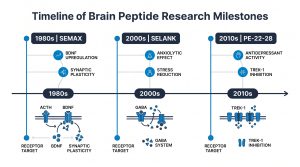
How Do BDNF and GABA Targets Compare in Studies?
BDNF effects via Semax. GABAergic effects via Selank are two new research paths with distinct assay systems and endpoints.
BDNF is a neurotrophic factor that supports neuron life. Semax research measures BDNF mRNA using RT-PCR assays on rodent brain tissue. Selank research uses behavior assays like the high plus-maze and open-field test, plus receptor binding studies that measure GABA-A receptor action. These two paths are not the same. A lab studying Semax needs new tools vs. One studying Selank.
What Does Research Say About TREK-1 as a Target?
TREK-1 (TWIK-related potassium channel 1) is a two-pore domain background potassium channel that controls resting membrane potential in neurons. Its levels in limbic brain regions have made it a subject of interest in mood-related brain research.
TREK-1 channels open in response to membrane stretch, heat, lipids. Anesthetics, and let potassium leave the cell to lower neuron firing rate. The Mazella et al. (2010) study showed TREK-1 knockout mice had antidepressant-like behavior in standard rodent assays. PE-22-28 was built to act on this target. Lab teams use patch-clamp tests to measure TREK-1 blocking and compare PE-22-28 against spadin and other reference compounds. High-purity peptide material is needed to avoid current artifacts from impurities.
Next Level Pharm stocks COA-verified, lot-numbered Semax, Selank, and PE-22-28. Visit the shop to view current batch data.
Frequently Asked Questions
What is the brain peptides comparison research area?
Brain peptides research looks at how neuropeptide analogs act on neural targets in lab models. Semax, Selank, and PE-22-28 each work through a distinct path. Published studies use assay systems from cell culture to rodent models. All findings are from lab models only and are not read as human clinical outcomes.
What makes Semax different from other brain peptides in research?
Semax is defined by its ACTH-derived origin. Its effect on BDNF levels in rodent brain tissue. The Dolotov et al. (2006) study found Semax raised BDNF and TrkB mRNA in hippocampal tissue. This focus on growth factors sets it apart from GABAergic peptides like Selank. Ion channel peptides like PE-22-28. Semax has a long study record going back to the 1980s.
How does Selank interact with the GABAergic system in research models?
Selank has been studied for its effects on GABA-A receptor action in rodent brain models. The Semenova et al. (2010) study showed Selank produced anxiolytic-like results in high plus-maze assays in line with GABAergic effects. Selank has also been studied for cytokine and enzyme effects, pointing to a multi-target profile beyond simple GABA receptor blocking.
What is PE-22-28 derived from and why is it a research peptide?
PE-22-28 comes from spadin, a peptide found in nature made by cleavage of the NTSR3/sortilin receptor propeptide. Spadin was found to be a natural TREK-1 channel blocker. PE-22-28 is an optimized analog. The Djillani et al. (2019) study found PE-22-28 blocks TREK-1 with about eight times greater power than spadin in patch-clamp assays.
Are Semax, Selank, and PE-22-28 studied in human clinical trials?
Semax and Selank have been studied in some clinical settings in Russia. Large-scale trials are not in the English-language literature. PE-22-28 is at an early stage, with data mainly from cell and rodent models. None of these compounds have FDA-approved uses. All three are sold only as research-grade compounds for lab use.
What assay systems are used to study these three peptides?
Semax research uses RT-PCR for BDNF mRNA and rodent behavior assays. Selank research uses high plus-maze, open-field test, and cytokine ELISA assays. PE-22-28 research relies mainly on patch-clamp tests to measure TREK-1 blocking. Each system needs distinct controls and setup steps. Compound purity affects all three assay types.
What purity level is needed for brain peptide research?
Research-grade brain peptides need high purity verified by HPLC and mass spec. The minimum standard is >=99% purity. A COA and lot number should come with each order. Lyophilized formulation supports long-term stability at recommended storage temperatures.
Can Semax and Selank be compared directly in research experiments?
A direct review is possible but needs distinct endpoint readouts. Semax targets growth factor levels while Selank acts on GABAergic and cytokine systems. A lab studying both would need new assays for each one. Published studies tend to look at each compound on its own rather than in combined protocols.
How are these peptides formulated for laboratory research?
All three compounds are sold as lyophilized (freeze-dried) powders. Lyophilization removes water and extends shelf life. Each is reconstituted in a buffer solution before assay use. Lyophilized peptides are stable at room temperature during shipping. Long-term storage at -20 degrees C is standard after receipt. Each vial includes COA data with HPLC and mass spec results.
Is there a preferred compound among the three for research?
There is no single preferred compound. Semax suits BDNF pathway research, Selank suits GABAergic and cytokine research. PE-22-28 suits TREK-1 channel research. Lab teams should choose based on their specific target, assay system, and hypothesis.
Summary
This brain peptides review covered three neuropeptide research compounds with new origins and targets. Semax is an ACTH(4-7) analog studied for BDNF effects in rodent brain tissue with a record going back several decades. Selank is a tuftsin-based heptapeptide studied for GABAergic effects and cytokine balance. PE-22-28 is a spadin analog studied for TREK-1 channel blocking using patch-clamp tests.
All three are supplied as lyophilized, research-grade peptides that need HPLC. Mass spec checks for reliable lab results. Each targets a new receptor system with its own lab endpoints.
What Should You Do Next?
Lab teams studying brain peptides can follow these steps. First, review primary studies on each compound via PubMed before designing experiments. Key studies are Dolotov et al. (2006), Semenova et al. (2010), and Djillani et al. (2019). Second, confirm your target receptor aligns with the compound’s documented action. Third, source COA-verified, lot-numbered research-grade peptides from a traceable supplier.
Shop research peptides to view COA-verified Semax, Selank, PE-22-28. Related brain research compounds at Next Level Pharm.
People Also Read
- Semax Research: BDNF Modulation and Neuroprotective Study Findings
- Selank Research: GABAergic Mechanisms and Published Study Review
About the Author
Next Level Pharm Research Team
Alex M covers peer-reviewed findings in peptide science for Next Level Pharm, a US-based supplier of research-grade peptides verified to ≥99% purity via HPLC and mass spectrometry on every batch.
Disclaimer: The information provided on this page is for educational and research purposes only. Next Level Pharm’s products are intended for laboratory research use only. They are not intended for human consumption, diagnostic, therapeutic, or medicinal purposes. This content does not constitute medical advice. Always consult a licensed healthcare professional before making any health-related decisions