
Peptide Stacking Research: Combined Peptide Study Models

Last updated: May 2026
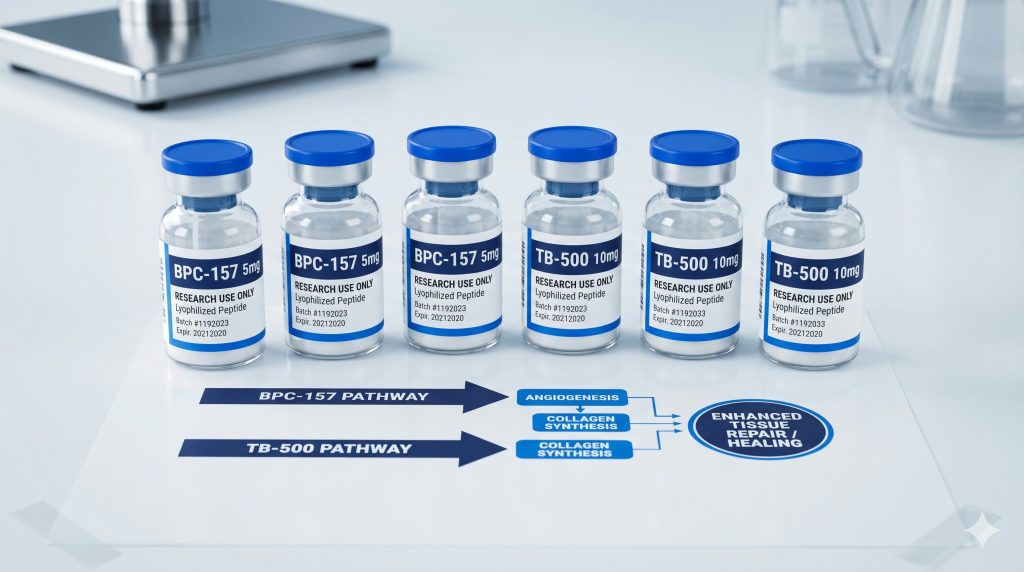
A peptide stacking study is a research design that uses two or more peptide compounds in the same lab model. Researchers study peptides together to see how different cell paths interact. BPC-157 and TB-500 are the most studied pair in tissue repair models. In lab studies, they show effects on growth factor paths and cell movement. All data here comes from lab and animal models only.
Next Level Pharm supplies each of these peptides as a COA-verified, lyophilized research compound. A certificate of analysis (COA) with a lot of ships with every order. Every batch is tested to ≥99% purity via HPLC and mass spec.
Researchers studying repair signals often work with more than one compound at a time. Knowledge of how peptides interact in models helps map cell path overlap. The sections below cover what the published research shows on combined peptide study designs.
Key Takeaways
- Peptide Stacking: A research design that studies two or more peptides in the same cell or animal model.
- BPC-157 and TB-500: The most studied pair in tissue repair models. Each acts on a different cell path.
- Study Design: Valid stack studies include individual-compound arms to isolate each peptide’s effects.
- GHK-Cu Research: GHK-Cu has been studied in mix models for effects on collagen and wound repair paths.
- Purity Standard: Each compound in a stack study must be ≥99% pure, confirmed by HPLC and mass spec.
- Research Context: All published data comes from lab and animal models. No human use data is presented.
Knowledge of how peptides interact in the same model is a growing area of lab research. The sections below cover the key mixes studied and what researchers have found.
What Is Peptide Stacking in Research?
Peptide stacking means studying two or more peptides in the same lab model. Researchers do this to see how different cell paths interact. A standard stack study has at least four groups: no peptide, peptide A alone, peptide B alone, and both together. This design lets researchers measure what the mix adds beyond each compound alone.
In repair science, tissues respond to many signals at the same time. New vessel growth, cell movement. Immune signals can all be active in a wound model at once. A single-peptide study captures only one path. A stack study captures how two paths behave when both are present. This is the main reason researchers design multi-peptide experiments. All published data comes from lab and animal models. No human use data is presented.
What Peptide Pairs Have Been Studied?
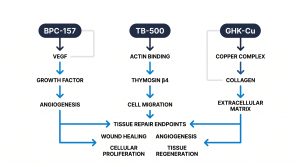
BPC-157 and TB-500 are the most studied peptide pair in the published literature. Each acts on a different cell path in wound and tissue repair models. BPC-157 targets growth factor paths. TB-500 targets actin binding and cell movement. Researchers study them together to see if their effects overlap at tissue repair endpoints.
According to Curr Pharm Des (2018), BPC-157 activates GHR (growth hormone receptor). VEGF (vascular endothelial growth factor) paths in tissue models. According to Nature (2004), thymosin beta-4 (Tb4), the base of TB-500, drives actin binding and cell migration. Researchers study both in tendon and muscle injury models. Other pairs include BPC-157 with GHK-Cu and BPC-157 with KPV in gut and skin repair models.
How Do Researchers Design Stack Studies?
A valid stack study uses at least four groups: a control (no peptide), compound A only, compound B only, and both together. This design shows what each compound does alone before measuring the combined effect. Without individual arms, it is hard to say which compound caused which result.
Each compound in a stack study must be tested at a known purity before use. HPLC (high-performance liquid chromatography) and mass spec (mass spectrometry) data confirm purity and identity. A COA for each lot gives researchers the test data they need. Researchers also check whether the compounds are stable in the same solvent before mixing. Some peptides can interact in solution. Preparing each compound as a separate stock. Mixing them just before use is the standard method in published studies.
What Does BPC-157 and TB-500 Research Show?
Published rodent studies on BPC-157 and TB-500 look at tissue repair endpoints. These include new vessel formation, collagen markers. Cell movement data in tendon and muscle injury models. Both compounds have published data on their own. Researchers also study them together.
BPC-157 has been studied in rat tendon injury models for effects on VEGF paths. Blood vessel density at repair sites. TB-500 has been studied in wound models for effects on actin binding and cell movement. These two paths are separate but can both affect the same repair endpoint. Next Level Pharm supplies BPC-157 as a COA-verified, lyophilized research compound. As of 2026, no peer-reviewed human trial data on combined BPC-157. TB-500 protocols have been published.
What Does GHK-Cu Mix Research Show?
GHK-Cu is a copper-binding tripeptide studied in wound and cell matrix models. Its role in stack studies is different from BPC-157 and TB-500. GHK-Cu is studied for effects on copper-dependent enzyme paths in skin and connective tissue cells.
According to BioMed Res Int (2015), GHK-Cu affects collagen and elastin production in skin cell models. It also affects wound repair and antioxidant enzyme signals. The copper ion (Cu2+) in GHK-Cu plays a role in enzyme activation at the cell level. In multi-peptide studies, GHK-Cu has been studied alongside BPC-157 for effects on wound model endpoints. Researchers look at whether copper-dependent paths add to growth factor paths in the same model. GHK-Cu suits research into collagen and skin matrix science.
How Do Common Peptide Pairs Compare?
The table below shows key differences between the most studied peptide pairs. Each pair targets a different set of cell paths. Researchers choose pairs based on the paths they want to study in their model.
| Peptide Pair | Primary Research Models | Pathway Focus |
| BPC-157 + TB-500 | Rodent tendon, muscle injury | Growth factor paths + actin binding |
| BPC-157 + GHK-Cu | Wound model, skin fibroblast culture | VEGF signaling + copper/matrix repair |
| BPC-157 + KPV | Intestinal rodent models | Tissue repair + immune signal paths |
| TB-500 + GHK-Cu | Wound closure, skin fibroblast models | Cell migration + collagen matrix |
BPC-157 and TB-500 suit tissue and wound repair research. BPC-157 and GHK-Cu suit matrix and skin repair studies. BPC-157 and KPV suit gut repair and immune signal research. Each pair is chosen based on study design, not as a fixed protocol.
Next Level Pharm stocks all of these compounds in its recovery peptide catalog. Each is sold as a separate, COA-verified research compound. Visit the shop to view current lot numbers and COA links.
Frequently Asked Questions
What is peptide stacking in research?
Peptide stacking means studying two or more peptide compounds in the same lab model. Researchers do this to see how different cell paths interact. BPC-157 and TB-500 are studied together in tissue repair models. KPV and GHK-Cu are studied in skin and gut models. Valid stack studies include individual-compound arms. This lets researchers see what each compound does alone before measuring the combined effect. All published data is from lab and animal models.
Why do researchers study peptides in mix?
Tissues respond to many signals at the same time. A single-peptide study captures only one path. Stack studies show how two paths behave when both are present in the same model. Researchers use this approach to map path overlap in wound, gut, and skin repair models. The goal is to understand how cell paths interact, not to design human treatment protocols. All stack research data comes from lab models.
What is the most studied peptide pair in the literature?
BPC-157 and TB-500 have the most published research data among peptide pairs in repair science. BPC-157 research focuses on VEGF-driven new vessel growth in tendon and muscle models. TB-500 research focuses on actin binding and cell migration. Researchers study both in rodent tendon injury models. Published data looks at vessel density and cell movement markers in the same model. No approved human use exists for this or any other peptide pair.
Are there human trials on peptide stacking protocols?
As of 2026, no peer-reviewed human trials on combined peptide stacking designs have been published. All existing multi-peptide data comes from cell cultures, tissue assays, and rodent models. Researchers who want to check the current trial landscape should search ClinicalTrials.gov for individual peptide names. Look for multi-arm study designs that include more than one peptide per arm. This is the most reliable way to check the current clinical research state.
What purity is needed for multi-peptide research?
High purity is key for valid stack studies. Impure compounds add variables that make endpoint results hard to read. The standard for published peptide research is ≥98% purity. The standard for these compounds is ≥99% purity. HPLC confirms identity and mass spec confirms molecular weight. A COA with a lot number for each compound gives researchers the test data they need before any combined study starts.
Can peptides in a stack interact in solution?
Yes. Two or more peptides in the same solution can interact through binding or charge effects. These interactions can change how each peptide behaves before it reaches the cell. Researchers check whether compounds are stable in the same solvent before combining them. The standard method is to prepare each compound as a separate stock solution. Mix them just before each experiment. This limits the time they spend in combined solutions.
What does synergy mean in peptide research?
Synergy means the combined effect of two compounds is greater than the sum of their individual effects. To show synergy, researchers need at least three study groups: compound A alone, compound B alone, and both together. Each group is compared to a control with no compound. Most published multi-peptide studies report additive effects, not true synergy. Showing true synergy needs tight control of concentration levels for each compound.
How is stability managed in peptide stack studies?
Peptide stability in stack studies is managed through solvent choice, pH control, and storage time. Lyophilized (freeze-dried) peptide powders are more stable than liquid forms. Researchers prepare each peptide as a separate stock and combine them just before each experiment. This limits time in mixed solutions. Long storage of pre-mixed peptide solutions is not standard practice. Each peptide should be stored by its own guidelines after receipt.
Where can researchers find published data on peptide pairs?
PubMed and the NIH database are the main sources for peer-reviewed peptide research. Search terms like BPC-157 thymosin beta-4 or combined peptide wound model return relevant results. ClinicalTrials.gov lists any registered trials. The three citations in this article link to specific studies on PubMed. Always verify that cited studies are primary research, not review summaries or conference abstracts without primary data.
What is the difference between additive and synergistic effects?
Additive effects mean the combined result equals the sum of each compound’s effect alone. Synergistic effects mean the combined result is greater than that sum. Most published multi-peptide studies report additive results. Synergy is harder to show and needs precise matching of concentrations for each compound. Researchers use both terms carefully in published work. Knowledge of the difference helps when reading multi-peptide study results and comparing endpoint data across models.
Summary
Peptide stacking in research means designing experiments that study two or more peptides together in a cell or animal model. The goal is to understand how peptides acting on different paths interact at shared endpoints. BPC-157 and TB-500 are the most studied pair in tissue repair models. GHK-Cu has been studied in mix for its role in copper-dependent matrix repair paths.
All current multi-peptide data is from lab and animal models. No combined peptide protocol has completed human clinical trials. Each compound in a stack study must be ≥99% pure and have a COA before any combined experiment starts.
What Should You Do Next?
Researchers planning multi-peptide studies can follow these steps.
- Review the comparison table above to match each peptide pair to the correct cell paths for your study.
- Download lot-specific COA documents to confirm purity for each compound before use.
- Browse the recovery peptide catalog to view vial sizes and lot numbers.
- Shop research peptides across all types, with free shipping on orders over $150.
View the BPC-157 product page for current lot data and COA links.
People Also Read
About the Author
Next Level Pharm Research Team
Alex M covers peer-reviewed findings in peptide science for Next Level Pharm, a US-based supplier of research-grade peptides verified to ≥99% purity via HPLC and mass spectrometry on every batch.
Disclaimer: The information provided on this page is for educational and research purposes only. Next Level Pharm’s products are intended for laboratory research use only. They are not intended for human consumption, diagnostic, therapeutic, or medicinal purposes. This content does not constitute medical advice. Always consult a licensed healthcare professional before making any health-related decisions