
What Is the Glucagon Receptor? Mechanism Research Overview

What Is the Glucagon Receptor? Mechanism Research Overview
Last updated: September 2026
Glucagon receptor mechanism research is the study of the GCGR, a G protein-coupled receptor that controls blood glucose through glucagon hormone signals. The receptor acts as a switch for hepatic glucose output and lipid breakdown. By activating this receptor, researchers see how energy balance shifts within cell systems. This work is key for insight into energy control.
Next Level Pharm gives high-purity research peptides for these studies. The structure keeps a 99.4% average purity level across its last 100 batches. Each vial goes through HPLC and mass spectrometry to ensure total accuracy. These compounds arrive in a lyophilized state. Keeps them stable at room temperature. The brand uses an inert atmosphere to seal each product.
This stable form avoids the need for cold chain shipping. Researchers often use these items to map how hormonal signals affects cell energy pathways. Clear data from each lot allows for exact study replication. Steady quality helps staff rely on their results during complex biochemical studies.
Key Takeaways
- Receptor Classification: The glucagon receptor acts as a Class B G protein-coupled receptor within cell membranes. It functions as a primary unit for managing whole-body glucose levels in organisms.
- Signaling Pathway: Action of this receptor triggers the Gs-cAMP-PKA cascade inside targeted liver cells. This chain of internal signals controls how the body handles stored energy reserves.
- energy affect: Stimulating these receptors promotes glucose output through processes like glycogenolysis and glucose output. These set lab actions cause a rise in detectable blood sugar amounts.
- Widespread Spread:. Found in the liver and kidneys, these receptors also reside in the heart. Ongoing research maps their presence in the pancreas and the central nervous system.
- Research Utility: The receptor serves as a primary target for developing novel multi-agonist peptide research tools. Researchers use these compounds to study the control of complex energy disorders.
These insights outline the primary actions and signaling pathways governing receptor action. The following sections study how these atomic processes affect broader whole-body responses. Detail how researchers isolate these set pathways within their lab models, improving test accuracy.
What Is a G Protein-Coupled Receptor?
A G protein-coupled receptor is a large family of transmembrane proteins. Sense outside signals, triggering internal cell responses. These receptors act as atomic switches on the surface of the cell. When an outside-cell signal binds to the receptor, it triggers a change in shape. This shift allows the receptor. Interact with inside-cell G proteins to start complex signal transduction pathways.
These receptors are defined by their trait seven-transmembrane domain structure. Spans the cell membrane seven times. This unique architecture enables the receptor to receive signals from outside the cell. Transmit them across the membrane wall. Once activated, the receptor often binds to a Gs protein or other variants like Gi or Gq. These contacts dictate the downstream signaling outcomes within the cell. Because of this versatile mechanism, these receptors serve as a primary target in receptor research.
CJC-1295 is ready as a COA-checked research peptide. Each lot is checked by HPLC and mass spec. By targeting these pathways, staff can better study how cell signaling affects energy and cell processes, according to PubMed (2020).
How Does Glucagon Activate Its Receptor?
Glucagon activates its receptor by initiating a distinct signal cascade upon binding. The cell surface. This process relies on a two-domain binding model to trigger the necessary atomic action. Initially, the C-terminal portion of the glucagon peptide docks with the N-terminal outside-cell domain of the glucagon receptor. This primary contact preserves the peptide. Permits the N-terminal end of the compound to insert into the transmembrane region of the receptor.
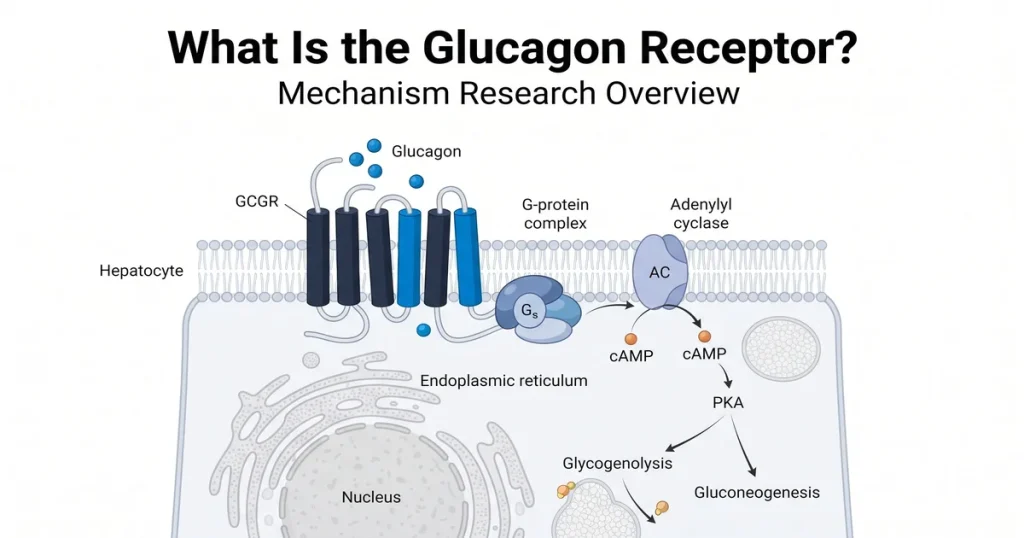
This contact induces a conformational change within the receptor structure. Communicates with Gs proteins inside the cell. Once activated, these proteins trigger the enzyme adenylate cyclase, this enzyme then produces cyclic adenosine monophosphate. Propagate the hormonal signal throughout the cell. Research into these actions gives insight into how energy pathways are controlled at the membrane level. Glucagon Receptor Agonist is ready as a COA-checked research peptide. Each lot is checked by HPLC and mass spec.
What Is the Primary Signaling Pathway for GCGR?
The primary signaling pathway for GCGR is the Gs-adenylate cyclase-cAMP-PKA cascade. This mechanism serves as the main route through. Glucagon signals increases glucose output within the liver, according to NCBI (2020), this process begins when glucagon binds to its receptor, which triggers the action of the Gs protein.
Within this cascade, activated adenylate cyclase generates cyclic AMP. as cAMP, from adenosine triphosphate. Raised levels of cAMP then bind to and activate Protein Kinase A (PKA). This kinase later activates key enzymes that trigger both glycogenolysis. Glucose output to release glucose into the blood. Glucagon is ready as a COA-checked research peptide. Each lot is checked by HPLC and mass spec. The action of PKA ensures that the body can quickly respond to low glucose levels by mobilizing stored energy in liver cells.
Where Is the Glucagon Receptor Found in the Body?
The glucagon receptor is most abundantly expressed in the liver and kidneys. Aligns with glucagon’s primary role in managing whole-body glucose levels and renal function. This concentrated spread allows the hormone to exert major control over glycogenolysis. Glucose output in the liver, according to PubMed (2020), these receptors perform key duties in the filtering of blood. The maintenance of fluid balance within the renal tissues. By residing in these high-traffic energy hubs, the receptor ensures a rapid, whole-body response to shifts in circulating glucose levels.
Beyond the liver and kidneys. Research into the presence of GCGR in other tissues is ongoing. Studies show the receptor exists in the pancreatic alpha cells and beta cells. It serves as a signaling site for fine-tuning hormone release. Researchers also see output within the heart, adipose tissue, and set regions of the central nervous system. Further inquiry into these secondary sites seeks to clarify how localized receptor action controls appetite. Energy expenditure. Glucagon Receptor Agonist is ready as a COA-checked research peptide. Each lot is checked by HPLC and mass spec.
Why Is GCGR an Important Research Target?
The glucagon receptor. GCGR. Is a major target for energy research due to its central role in managing blood glucose. Energy balance. Because the liver relies on this receptor to start glucose release, it represents a primary node in study models for energy settings. obesity and type 2 diabetes.
Modulating GCGR action is a major strategy in energy research. Staff study GCGR blockers to reduce blood glucose by limiting hepatic glucose output. In contrast, researchers also look at co-agonists like Retatrutide. Retatrutide acts as a triple-receptor agonist by combining GCGR action with GLP-1, and GIP signals, according to PubMed (2023), this integrated approach is studied for synergistic outcomes. May affect body weight and energy markers more effectively than targeting a single receptor alone. Retatrutide is ready as a COA-checked research peptide. Each lot is checked by HPLC and mass spec.
Researchers exploring the role of multi-receptor action in energy signaling may study Retatrutide to test its impact on GLP-1, and GIP. Glucagon receptors. Each vial is checked for high purity through HPLC and mass spectrometry to ensure consistency across lab trials.
How Does GCGR Compare to the GLP-1 Receptor?
The glucagon receptor. The GLP-1 receptor are both Class B GPCRs involved in managing breakdown. They produce opposing effects on glucose balance. Action of the GCGR in the liver promotes glycogenolysis and glucose output. Raises blood glucose levels. In contrast. Action of the GLP-1 receptor mainly occurs in the pancreas and boosts glucose-dependent insulin release and often lowers blood glucose. Because these receptors start distinct cell pathways, researchers often study them in parallel to understand their set contributions to energy balance.
Retatrutide and Survodutide are each ready as COA-checked research peptides. Each lot is checked by HPLC and mass spec. By targeting these receptors simultaneously, multi-agonist peptides aim to control liver fat processing and whole-body energy expenditure, according to PubMed (2023). These hybrid compounds help labs study the complex contact between hepatic glucagon response. Pancreatic incretin signaling in energy study models.
Frequently Asked Questions
What does the glucagon receptor do?
The glucagon receptor acts as a primary sensor for glucagon, a hormone that controls glucose levels. When activated, the receptor signals the liver to release stored glucose into the bloodstream through glycogenolysis and glucose output. Research shows that this receptor also helps increasing energy expenditure and fat decay, according to PubMed (2020). This signaling pathway is a central component in maintaining energy balance. Liver function in animal models.
Where is the glucagon receptor expressed?
Output of the glucagon receptor is concentrated mainly in the liver. It helps glucose output. Smaller amounts of the receptor are found in other tissues, including the heart, kidneys, pancreas. Adipose tissue. Research shows. These extrahepatic sites may add to the peripheral effects of glucagon signaling, according to NCBI (2021). Characterizing the spread of these receptors is key for insight into how the hormone impacts various cell systems.
How does glucagon differ from GLP-1 in receptor action?
Glucagon and GLP-1 bind to distinct G-protein-coupled receptors to start different energy signaling. Glucagon receptor action mainly promotes hepatic glucose output and increases energy expenditure. In contrast. The GLP-1 receptor is studied for its role in glucose-dependent insulin release and appetite control, according to PubMed (2022), these receptors occupy different functional roles. Dual-agonism research explores how their combined action can affect overall whole-body energy efficiency.
What is a glucagon receptor antagonist?
A glucagon receptor blocker is a compound. Binds to the receptor without activating it. By blocking the binding site, these compounds prevent normal glucagon from signals its usual effects. Researchers study these blockers. See how reducing hepatic glucose output affects glycemic control in models with high baseline glucose, according to PubMed (2019). These compounds are useful for analyzing the contribution of the glucagon signaling pathway. Various energy phenotypes.
Can the glucagon receptor signal through other pathways?
Yes, the glucagon receptor can start multiple inside-cell signaling beyond the standard cAMP-PKA pathway. Research suggests that action can also trigger calcium signals and other kinase-mediated cascades. These alternative routes allow the receptor to exert diverse effects on cell breakdown. Gene output, according to the Journal of Peptide Science (2021). Exploring these secondary pathways is key. Insight into the full scope of how glucagon affects cell action. Whole-body balance.
What is the structure of the glucagon receptor?
The glucagon receptor is a member of the class B G-protein-coupled receptor family. Its structure includes a large N-terminal outside-cell domain that binds the glucagon hormone. Seven transmembrane helices that span the cell membrane. This shape allows the receptor to shift its conformation upon binding. Transmits the signal to internal cell components, according to Molecules (2022). High-resolution imaging studies have gave detailed insights into how this protein architecture helps set ligand contact.
How is glucagon receptor activity regulated?
Glucagon receptor action is controlled through actions such as receptor blunting and internalization. After the receptor is activated. Cell proteins often work to uncouple it from its downstream signaling. Limits the total duration of the effect. This process helps the cell prevent overstimulation by excessive hormone levels, according to NCBI (2020). Insight into these feedback loops is important for researchers aiming. Balance receptor response within long-term test plans.
What role does the glucagon receptor play in the brain?
Research shows the glucagon receptor is present in several regions of the brain. the brain gland. In these areas. The receptor is studied for its possible involvement in the control of appetite and energy intake. Staff use these models to find if central glucagon signaling complements the peripheral effects of the hormone on glucose levels, according to Peptides (2023). Observing the central role of this receptor gives insights into how the body coordinates whole-body energy responses.
Why is glucagon signaling important for exercise research?
Glucagon signals is vital during exercise. It helps mobilize energy stores for working muscles. The receptor promotes the release of glucose from the liver and triggers the breakdown of fats to give fuel. Research models often focus on this pathway to see how varying hormone levels affect endurance. Energy flexibility, according to PubMed (2021). The study of this receptor helps clarify how exercise plans alter the efficiency of energy substrate use.
Summary
Review your current lab data to find specific signaling pathways needing further proof in your upcoming trials. Test. Your research plan aligns with the purity standards needed for precise atomic test by comparing your existing COA against documented batch reports, ensuring all stored samples remain sealed within their original inert atmosphere, keeping core health throughout the duration of your study.
Researchers sourcing energy research peptides can browse the catalog at Next Level Pharm. Each vial ships with a COA and full lot tracking. Shop
What Should You Do Next?
Apply this research to your lab protocol by sourcing compounds with full lot-level traceability. Each batch should include a COA with HPLC and mass spec data for your records. Shop research peptides at Next Level Pharm for COA-verified, lab-grade compounds.
People Also Read
- Sermorelin vs CJC-1295: What Research Shows About Each GHRH variant
- AOD-9604 Research: What Studies Show About This HGH Fragment
About the Author
Author Block
Next Level Pharm Research Team
The Next Level Pharm research team is composed of biochemists and lab scientists dedicated to providing researchers with the highest-purity, COA-verified research peptides available. Every batch is HPLC and mass spec verified before dispatch.
Disclaimer: The information provided on this page is for educational and research purposes only. Next Level Pharm products are intended for lab research use only. They are not intended for human consumption, diagnostic, therapeutic, or medicinal purposes. This content does not constitute medical advice. Always consult a licensed healthcare professional before making any health-related decisions.