Peptide Cost Per Milligram: A Research Comparison

Last updated: August 2026
A peptide cost per milligram analysis is the method for finding the true price of a research peptide. It adjusts for vial size, purity, and net peptide content. This process accounts for mass beyond the pure amino acid chain. Such mass includes counterions, salts, and residual water. The result is the cost of the actual active compound. Researchers use this ratio to compare value across varying lot specs. A 2023 PubMed study confirms that peptide mass checks are key for accurate titration in lab settings.
Next Level Pharm provides high-purity research compounds for lab use. Its inventory maintains an average purity of 99.4% across the last 100 batches. The lab team performs dual-method testing on every vial. This uses HPLC and mass spectrometry (MS). Every order includes a Certificate of Analysis (COA). Every batch is third-party tested.. All compounds are freeze-dried and stored at room temperature. This ensures stability during transport. The team maintains active inventory across 70+ research categories.
Cost analysis ensures researchers know the specific substance amount before starting bench-top experiments. High-purity peptides often carry higher manufacturing needs. This affects the total mg per dollar. Adjusting for mass and purity creates a clear benchmark for budget planning. This lets researchers focus on study design and data collection. Next Level Pharm ensures every batch meets rigorous purity standards before it enters the research supply chain.
Key Takeaways
- Calculate the true cost: Find the price per mg by dividing the total cost by the net peptide weight. Net weight is the stated mass multiplied by the actual purity percentage.
- Understand purity metrics: Peptide purity is confirmed using HPLC and reported in a COA. This percentage identifies the exact amount of usable compound in any given vial.
- Account for hidden costs: Factor in shipping fees and supplies such as bacteriostatic water. Some researchers also add costs for outside lab testing to confirm lot quality.
- Distinguish net from gross: Vials contain inactive fillers from the freeze-drying process. The total vial mass always differs from the net peptide content available for study.
- Verify with lot data: Always match research compounds to a recent, lot-specific COA. This document must include both HPLC and MS data for accuracy.
The next sections give a practical framework for integrating these metrics into lab procurement. You will find specific methods for adjusting data and maintaining consistency across research projects.
How Is Cost Per Milligram Calculated?
Calculating cost per mg is straightforward. Divide the total vial price by the net mg of the peptide compound. This formula gives a base starting point. It lets you compare different research offerings. A raw cost figure can be misleading. It ignores the true yield of the active substance. A vial might appear cheap but contain lower net peptide content. This raises the real cost for each active mg.
Relying on the gross weight on a label can lead to wrong data. Researchers must consult the COA. It shows the actual purity percentage of the sample. The COA shows how much of the total weight is the intended compound. The rest is filler or moisture. Researchers sourcing BPC-157 can access lot-specific HPLC data through the COA. This verifies net active content. Dividing the total price by the net active mg gives a clear metric. It supports resource planning.
Why Does Net Content Affect the Real Cost?
Net peptide content affects the real cost because the total vial mass includes inert fillers. These are not part of the active peptide. Researchers often assume the label weight represents the pure compound. But vials contain non-peptide fillers remaining from the freeze-drying process. The price is paid per mg of total material. A lower net peptide percentage raises the true cost per mg of the active chain.
Freeze-drying agents, such as mannitol, are added to preserve the peptide structure during drying. These agents, along with acetate salts, add mass to the final product. They have no active function in lab research. When net peptide content is lower, a larger portion of the vial weight is inert. This matters for precise cost work. Researchers across the fitness and growth hormone peptide catalog should apply the same net-content calculation to each compound.
How Does Purity Impact Usable Material?
Purity directly reduces the amount of usable material in a vial. Contamination displaces the mass of the target compound. High-Performance Liquid Chromatography (HPLC) separates the primary chain from synthesis byproducts. The remaining percentage that is not pure peptide represents inactive weight. When a vial contains high levels of these contaminants, the effective cost per mg rises. The researcher receives less active substance per unit.
For example, a 10 mg vial with 99% purity provides 9.9 mg of the desired peptide. A 95% pure sample offers only 9.5 mg. The 4% purity difference means a loss of 0.4 mg of active material. This creates a higher cost per mg for the lower purity option. The researcher pays for inactive elements rather than the primary chain. According to PubMed (2023), cutting synthesis contaminants is critical for reliable data sets. This applies to any lab setting.
| Purity Level | 10 mg Vial Yield | 5 mg Vial Yield | Active Loss vs. 99% |
| 99% | 9.90 mg | 4.95 mg | Baseline |
| 97% | 9.70 mg | 4.85 mg | -0.20 mg |
| 95% | 9.50 mg | 4.75 mg | -0.40 mg |
| 90% | 9.00 mg | 4.50 mg | -0.90 mg |
What Are Common Hidden Research Costs?
Common hidden research costs include shipping fees, key supplies, and the expense of outside testing. Procuring peptides involves more than the list price. Expenses add up quickly. Labs need items to maintain sterile handling and verify study data.
Shipping fees fluctuate based on location and weight. Some suppliers offer free shipping thresholds. These affect total costs. Beyond transit, researchers must budget for supplies. These include bacteriostatic water, vials, and syringes. These are needed for any research project. The cost of outside third-party testing adds precision to research. It gives a second check on the purity data claimed by a supplier. These combined factors often create a big difference between the list price and the final cost.
How Do COAs Verify Peptide Cost and Quality?
A COA verifies peptide cost and quality by giving objective purity data. It also gives MS results for a specific lot. The document is the primary source for finding the exact amount of active material within a vial. By using the HPLC chromatogram, a researcher calculates the actual mass of the peptide versus filler content. This ensures the total price paid reflects the amount of usable substance.
The review must include lot number traceability. This ensures the testing matches the specific batch in hand. A lab that gives results without clear batch identifiers cannot verify its claims. Checking the testing date and the chromatogram allows for a well-informed calculation of the net peptide content. Consistent reporting across these metrics supports the integrity of the research budget. All lots go through outside testing to ensure consistent compound quality.
Where Do Low-Cost Peptides Often Fall Short?
Low-cost peptides often fall short. They lack clear quality testing. This leads to wrong concentrations and synthesis contaminants that render results unusable. These budget options often bypass the rigorous testing steps. These steps are needed to confirm a vial contains the stated amount of the target peptide. Researchers may find batches with large amounts of truncated chains or leftover reagents from the manufacturing process.
The absence of verifiable testing creates unreliable outcomes. The actual makeup of the vial remains unknown. Any initial price savings disappear quickly. A researcher must factor in the higher cost of replacing compromised material or correcting for skewed data. Using high-quality compounds is the only way to ensure the integrity of lab findings over time. Researchers can shop research peptides with full COA documentation to verify quality before purchase.
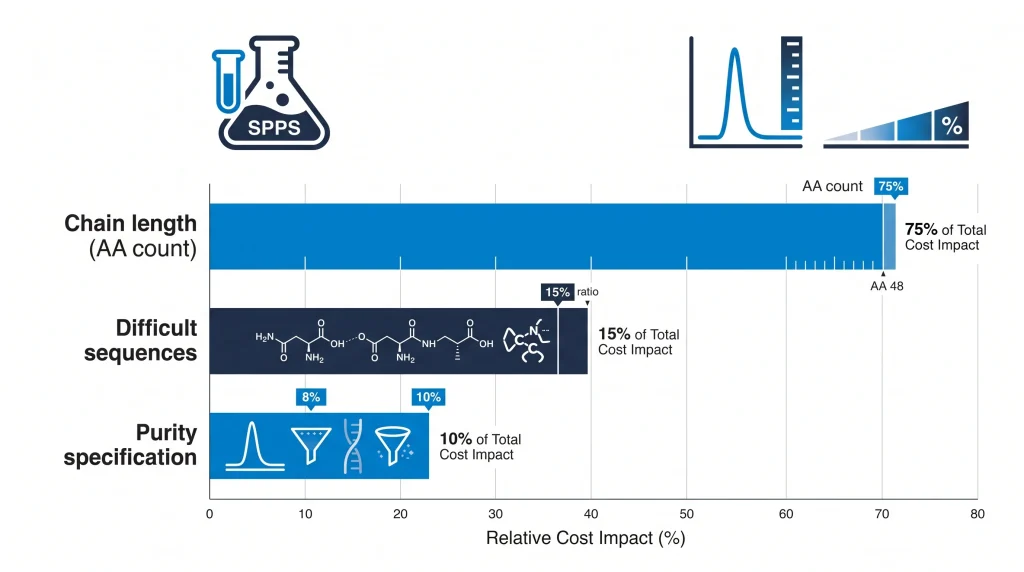
According to PubMed (2023), peptide synthesis cost per mg scales with chain length, difficult sequences, and purity level. According to PubMed (2005), solid-phase peptide synthesis has reduced per-mg production costs since the 1990s. According to PubMed (2017), lab analysis costs including HPLC and MS make up a fixed portion of total peptide cost.
Frequently Asked Questions
How Is Cost Per Milligram Calculated?
To find cost per mg, divide the total purchase price by the exact active peptide mass. This is the mass of the compound in the vial. Research accuracy depends on knowing the net peptide content. The gross vial weight is not enough. Dividing total dollars by net mg reveals the true price per unit of active material. According to PubMed (2023), this approach sets a clear standard for comparing different lots and sources.
Why Does Net Peptide Content Change the Real Cost?
Net peptide content measures the pure mass of the target chain. It excludes salt compounds and trapped moisture. Because vendors often price compounds by gross weight, a vial with low net content costs more. It is more expensive than it appears. Every percentage point of non-peptide material represents a hidden cost to the researcher. By adjusting cost against net content, the financial burden of inert fillers becomes clear to the lab.
How Does Purity Affect Usable Material?
High-purity peptide samples contain fewer synthesis byproducts. These include incomplete chains and reactant leftovers. When purity is lower, a larger percentage of the material lacks the activity needed for research. This affects specific research models. Lower purity vials require larger quantities to reach the target amount of the desired peptide. Identifying the exact purity level is a requirement for data quality. It also ensures consistent research results.
What Hidden Costs Appear in Shipping and Testing?
Hidden costs include shipping and the expense of secondary testing to check vendor claims. While shipping may appear minor, the time spent sourcing replacements for low-quality batches adds costs to a project. Paying for outside lab validation ensures the accuracy of test data. These efforts protect the study from the costs linked to corrupted or unreliable samples. Samples must meet set quality benchmarks before use.
Why Do Low-Cost Vials Often Test Lower?
Low-cost vials often prioritize scale over expensive purification and testing steps. Manufacturing processes may lack the strict oversight needed to remove all synthesis residuals or ensure consistent batch quality. This results in vials with higher contaminant levels and reduced net content. Consistent adherence to rigorous production protocols is a key factor in maintaining high-grade peptide quality standards. According to PubMed (2017), this is well established in the research literature.
How Can a Certificate of Analysis (COA) Verify Quality?
A COA provides proof that the specific batch underwent analytical testing through methods like HPLC. This document lists the purity percentage. It also identifies the target peptide chain through MS. Researchers use these test reports to cross-reference the batch in their hands with official data. If a COA is missing or lacks a lot specificity, the quality of the peptide remains unverified. It may be unsuitable for precise scientific study.
Do Fillers or Excipients Add to Total Vial Weight?
Freeze-drying agents, such as mannitol, are common additives used to give structure to the peptide during the drying process. These agents, along with acetate or trifluoroacetate salts, add to the total mass on the vial label. These compounds have no research utility on their own. They only add mass to the vial. This does not increase the amount of active substance. The gross weight goes up but the net peptide content stays the same.
Is Third-Party Testing Necessary?
Outside testing provides an independent check on the results reported on a vendor’s COA. It removes possible bias. It also ensures the data reflects the current state of the material. Even when a vendor provides documentation, a check by an outside lab adds objective security. This removes possible bias. This helps confirm the peptide meets the needs of a study. It gets added to a specific research design only then.
Can a Lower Price Mean a Higher Research Expense?
A lower initial price often disguises the higher expense of buying extra material to compensate for low purity. If a researcher must use more powder to achieve the needed active level, the cost per experiment rises. The higher cost is often hidden. The time lost due to errors from impure substances creates an unseen cost burden. Investing in high-purity, verified material often represents a more efficient use of resources for long-term research.
What Key Information Belongs on a Legitimate COA?
A valid COA must feature the specific lot number and the date of testing. It must also show results from both HPLC and MS. It should clearly state the purity percentage of the target peptide. Contact information for the lab conducting the tests helps verify the source. It confirms the report is legitimate. Legitimate reports always link the data to a specific batch. This makes the findings verifiable and relevant to the actual vial in use.
Summary
Peptide cost per mg analysis reveals the true value of a research compound. It accounts for purity, net content, and hidden procurement costs. Gross vial weight and list price rarely reflect the actual level of active material available for study. Researchers who adjust for net content and verified purity make more informed purchasing decisions.
COA documentation is the primary tool for verifying that a lot delivers its stated value. High purity, lot-specific HPLC data, and clear MS results are the markers of a reliable research-grade compound. Factoring in all associated costs ensures accurate budget planning for ongoing lab work.
What Should You Do Next?
Researchers sourcing research-grade peptides for lab studies can follow these steps:
- Review purity documentation. Confirm that COA data is available for the batch before ordering. Next Level Pharm provides lot-specific COA access for each vial.
- Check compound storage requirements. Freeze-dried peptides stay stable at room temperature during shipping. Confirm your lab has the correct storage protocol before beginning work.
- Request technical support if needed. PhD-level biochemist support is available for researchers with protocol-specific questions about research applications.
People Also Read
- What Makes a Peptide Research Grade? Standards and Testing Explained
- BPC-157 Mechanism of Action: A Research-Based Explainer
About the Author
Next Level Pharm Research Team
The Next Level Pharm research team is composed of biochemists and laboratory scientists dedicated to providing researchers with the highest-purity, COA-verified research peptides available. Every batch is HPLC and mass spec verified before dispatch.
Disclaimer: The information provided on this page is for educational and research purposes only. Next Level Pharm’s products are intended for laboratory research use only. They are not intended for human consumption, diagnostic, therapeutic, or medicinal purposes. This content does not constitute medical advice. Always consult a licensed healthcare professional before making any health-related decisions.