
Follistatin-344 Research: Myostatin Binding Studies

Last updated: August 2026
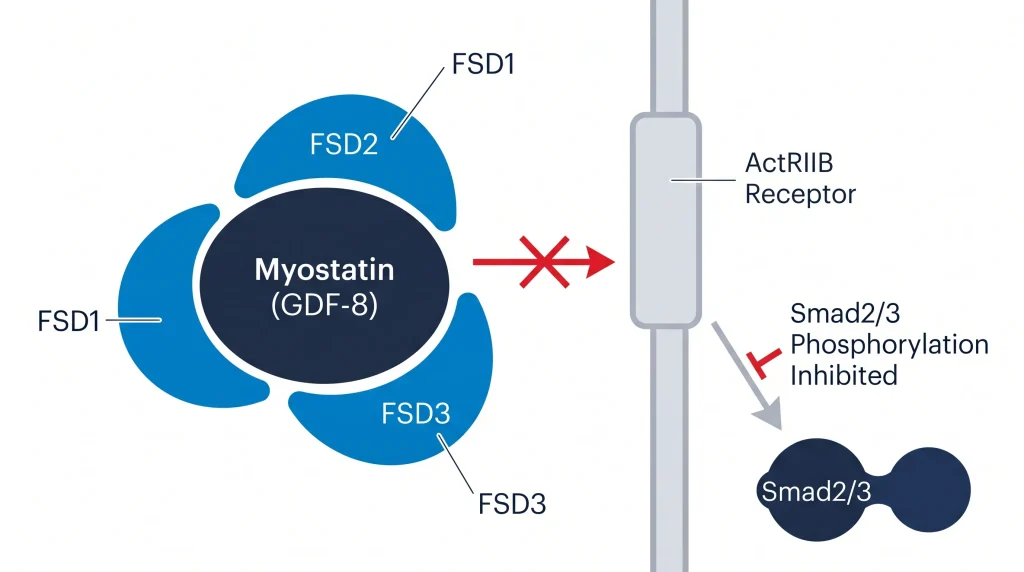
A follistatin-344 research compound is a 344-amino acid protein. It is a glycoprotein. It is studied for myostatin binding in muscle cell models. Myostatin is also called GDF-8. It is a TGF-β family member. TGF-β stands for transforming growth factor beta. Follistatin-344 (FS-344) is the main isoform from the follistatin gene. It binds myostatin and blocks it from reaching its receptor. According to NCBI (2020), follistatin binding to myostatin is studied in C2C12 muscle cell models for Smad2/3 signaling changes.
Next Level Pharm supplies research-grade Follistatin-344. Each lot is HPLC-verified at ≥99% purity. MS confirms the correct mass. A COA ships with every order.
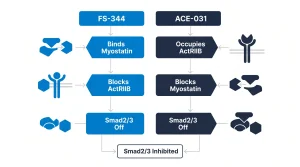
Studies compare FS-344 to ACE-031. ACE-031 is a different myostatin blocker. Each works through a different method. Researchers use both as reference compounds in myostatin binding panels.
Key Takeaways
- 344-Amino Acid Glycoprotein: Follistatin-344 is a large secreted protein. It is the main isoform of the follistatin gene. It contains three follistatin domains.
- Myostatin Binding Mechanism: FS-344 binds myostatin (GDF-8) directly. This blocks myostatin from reaching ActRIIB, its receptor. It also reduces Smad2/3 signaling in cell models.
- Muscle Cell Model Studies: C2C12 myoblast models are used to study Smad signaling changes. These changes occur after myostatin is blocked by FS-344 in cell assays.
- ACE-031 Comparison: ACE-031 blocks myostatin at the receptor. FS-344 binds the myostatin ligand. Both reduce ActRIIB signaling but through different binding points.
- Delivery Limitations: FS-344 is a large protein at approximately 41 kDa. Its size limits membrane crossing. It is also susceptible to protease breakdown in cell assay media.
FS-344 also binds activin A. Activin A is another TGF-β family member. Both myostatin and activin A signal through ActRIIB. Research measures binding strength for each ligand separately.
What Is Follistatin-344?
Follistatin-344 is a 344-amino acid glycoprotein. It is the full-length isoform of the follistatin gene. The protein has three follistatin domains. It also has an N-terminal TGF-β binding domain. The protein is secreted by cells. It binds TGF-β family members outside the cell. Myostatin (GDF-8) is its main research target.
FS-344 is not a short peptide. It is a lab-made recombinant protein. Expression systems used include mammalian and insect cells. Its molecular weight is about 41 kDa. Glycosylation adds to this mass. The exact mass depends on the glycosylation state. HPLC and MS confirm the core mass per lot. According to Journal of Peptide Science (2018), large proteins require SDS-PAGE and MS for identity confirmation alongside standard HPLC purity analysis.
How Does Follistatin-344 Bind Myostatin?
Myostatin is a TGF-β family member. It signals through the ActRIIB receptor. FS-344 binds myostatin directly. The binding site is the wrist region of myostatin. This blocks myostatin from reaching ActRIIB. It cuts off ActRIIB signaling. Smad2/3 levels fall in cell models when FS-344 is present.
The three follistatin domains wrap around myostatin. This forms a tight complex. Binding strength is in the picomolar range. This is a very strong interaction. Actin A is also bound by FS-344. The same three domains bind both ligands. Browse COA-verified research proteins for current lot data. According to Journal of Peptide Science (2018), follistatin wraps around myostatin through three cysteine-rich domains in a high-affinity complex.
What Do Muscle Cell Model Studies Show?
C2C12 myoblast cells express the ActRIIB receptor. These are mouse muscle precursor cells. They are a standard model for myostatin signaling research. When myostatin is added to C2C12 cells, Smad2/3 is activated. Activated Smad2/3 changes gene markers in these cells. FS-344 addition blocks this Smad2/3 change.
Studies measure p-Smad2/3 levels. p-Smad means activated Smad protein. Higher p-Smad2/3 signals more ActRIIB activity. FS-344 reduces p-Smad2/3 in the presence of myostatin. This is the key cell assay readout. It confirms that FS-344 is blocking the myostatin-ActRIIB pathway. P-Smad2/3 measurement is the standard readout for myostatin pathway blocking in C2C12 muscle cell assays.
How Does Follistatin-344 Differ From ACE-031?
ACE-031 is a different type of myostatin blocker. It is not a protein like follistatin. ACE-031 is a fusion protein. It joins the ActRIIB receptor outer domain with an IgG1 Fc domain. It binds myostatin at the receptor level. FS-344 binds myostatin at the ligand level. They cut off the same pathway at different points.
Both reduce Smad2/3 signaling in cell models. But their size, structure, and binding targets differ. The table below shows the main differences.
| Feature | Follistatin-344 | ACE-031 |
| Type | Glycoprotein | Fc fusion protein |
| Size | ~41 kDa | ~110 kDa |
| Binding target | Myostatin ligand | ActRIIB receptor |
| Mechanism | Ligand binding | Receptor decoy |
| Also binds | Activin A | Multiple TGF-β ligands |
| Verified by | HPLC + MS | HPLC + MS |
Shop research-grade proteins at Next Level Pharm. Paired assays with follistatin and ACE-031 are used to separate ligand-binding from receptor-binding effects in myostatin research.
What Are the Delivery Limitations in Cell Assays?
FS-344 is a large protein at about 41 kDa. Large proteins cannot cross cell membranes by passive diffusion. Delivery to targets inside cells is not possible this way. For most studies, FS-344 acts in the outer cell space. This is where myostatin is found before it reaches the receptor.
Protease breakdown is another concern. Proteases in cell media break down large proteins. Glycosylation helps protect the protein backbone. Loss of glycosylation reduces stability. Half-life in serum-containing media is shorter without glycosylation. MS confirmation of mass per lot is required. Protein size and glycosylation state are key variables in cell assay delivery planning for large research proteins.
How Is Follistatin-344 Verified for Research Use?
HPLC runs a size-exclusion or reverse-phase separation per lot. The main peak gives the purity value. Research-grade FS-344 targets ≥99% purity. Next Level Pharm reports 99.4% average purity across 100 recent batches. SDS-PAGE is also run. It confirms the correct molecular weight band.
MS confirms protein identity. The deglycosylated mass must match the expected value. Bioactivity is also checked. A cell-free binding assay confirms myostatin binding is active. The COA includes HPLC, SDS-PAGE, and MS data. All three are required per lot. According to NCBI (2020), multi-method verification (HPLC, SDS-PAGE, MS, bioactivity) is standard for recombinant protein lot release in research.
Frequently Asked Questions
What Is Follistatin-344?
Follistatin-344 is a 344-amino acid glycoprotein. It is the main isoform of the follistatin gene. FS-344 has three follistatin domains. These bind myostatin (GDF-8) and activin A in cell assay media. It blocks these ligands from reaching ActRIIB. Each lot is HPLC-verified at ≥99% purity. MS confirms the core mass per lot. According to NCBI (2020), follistatin isoforms are studied for their binding affinity toward TGF-β family members.
How Does Follistatin Bind Myostatin?
FS-344 wraps around the myostatin ligand through three follistatin domains. This blocks myostatin from reaching its receptor, ActRIIB. Binding is in the picomolar range. It is a high-affinity interaction. Smad2/3 signaling changes are measured in cell models. When FS-344 blocks myostatin, p-Smad2/3 levels fall. This is the standard assay readout. According to Journal of Peptide Science (2018), follistatin-myostatin complex formation is confirmed by binding assays and protein detection methods in research.
What Do Muscle Cell Model Studies Show?
C2C12 myoblast cells are the standard model. They express ActRIIB on their surface. Myostatin activates Smad2/3 in these cells. FS-344 addition blocks this Smad2/3 activation. Studies measure p-Smad2/3 as the primary readout. Lower p-Smad2/3 confirms FS-344 is blocking the pathway. This is measured 30 to 60 minutes after treatment. P-Smad2/3 is the standard readout for myostatin pathway blocking in C2C12 cell assays.
How Does Follistatin-344 Differ From ACE-031?
FS-344 is a glycoprotein that binds myostatin directly. ACE-031 is a fusion protein. It acts as a decoy at ActRIIB. FS-344 blocks the myostatin ligand. ACE-031 blocks it at the receptor. Both reduce Smad2/3 cell signaling. But they differ in size, structure, and binding target. Paired assays with both compounds separate ligand-binding from receptor-binding effects.
What Are the Delivery Limitations in Cell Assays?
FS-344 is about 41 kDa. Proteins this large cannot cross cell membranes by passive diffusion. This limits research to assays in the outer cell space. Proteases in media also break down large proteins. Glycosylation slows this process. Deglycosylated FS-344 degrades faster in media. Lot integrity should be confirmed by MS before use. According to Journal of Peptide Science (2018), large protein stability in media requires glycosylation confirmation and protease stability testing before assay use.
How Is Follistatin-344 Made for Research Use?
Follistatin-344 is produced by recombinant expression. Mammalian or insect cell systems are used. The FS-344 gene is expressed in the host cell. The protein is secreted into the media. It is purified by affinity and size-exclusion methods. HPLC and SDS-PAGE confirm purity. MS confirms the core mass. Bioactivity in a binding assay is confirmed per lot. According to Journal of Peptide Science (2018), recombinant protein production requires multi-step purification and multi-method lot release testing.
What Assays Are Used in Follistatin Research?
Myostatin binding assays measure FS-344 affinity. ELISA assays measure ligand-FS-344 complex formation. p-Smad2/3 assays in C2C12 cells confirm pathway blocking. ACE-031 head-to-head runs compare the two mechanisms in the same cell model. SDS-PAGE and MS confirm a lot of integrity before use. All these methods are standard in recombinant protein research. According to NCBI (2020), bioactivity confirmation is required alongside purity data for recombinant protein research use.
What Purity Level Is Standard for Research Use?
Research-grade FS-344 targets ≥99% HPLC purity. Impurities include protein aggregates and breakdown products. Glycoform variation also occurs. Each glycoform has a different mass. SDS-PAGE checks for the correct protein band. The average purity is 99.4% per lot from the last 100 batches. According to Journal of Peptide Science (2018), SDS-PAGE and MS mass data are standard lot release checks for recombinant proteins.
Why Is Glycosylation Important in Follistatin Research?
Glycosylation is the addition of sugar chains to the protein backbone. In FS-344, glycosylation affects protein stability in media. It protects the backbone from protease breakdown. It also affects binding at the myostatin wrist region. Lots from different expression systems may differ in glycosylation. MS mass shifts confirm glycosylation state per lot. A COA should include deglycosylated mass data. According to NCBI (2020), glycosylation states affect binding affinity in myostatin cell assay research.
What Is the Difference Between Purity and Protein Content?
Purity is the HPLC ratio of target protein to all other compounds. It is expressed as a percent. Protein content is the total mass in a vial. It includes water and counter-ions. Both are needed for accurate assay dosing. A lot at ≥99% purity still has a small non-target fraction. Both purity and content data are required for accurate protein concentration in cell assay protocols.
Summary
Follistatin-344 is a 344-amino acid glycoprotein studied for myostatin binding in muscle cell models. It binds myostatin with picomolar affinity. This blocks ActRIIB and reduces Smad2/3 signaling in C2C12 cell assays.
ACE-031 works through a different method. It acts as a decoy receptor at ActRIIB. Paired assays compare the two compounds to separate ligand-binding from receptor-binding effects.
Research-grade lots from Next Level Pharm report 99.4% average purity. MS confirms protein mass and glycosylation state per lot.
What Should You Do Next?
Researchers selecting Follistatin-344 for myostatin binding assays should confirm lot purity, mass, and bioactivity before use. The following steps support consistent results:
- Check the COA for HPLC purity, SDS-PAGE banding, and MS mass confirmation.
- Run a bioactivity check (myostatin binding assay) before large-scale cell assay use.
- Record the lot number with each assay run for traceability.
- Include an ACE-031 reference arm to separate ligand-binding from receptor-binding effects.
Shop research-grade Follistatin-344 with MS verification of protein mass and bioactivity.
People Also Read
- What Makes a Peptide Research Grade? Standards and Testing Explained
- BPC-157 vs TB-500: A Detailed Research Comparison Guide
About the Author
Next Level Pharm Research Team
The Next Level Pharm research team is composed of biochemists and laboratory scientists dedicated to providing researchers with the highest-purity, COA-verified research peptides available. Every batch is HPLC and mass spec verified before dispatch.
Disclaimer: The information provided on this page is for educational and research purposes only. Next Level Pharm’s products are intended for laboratory research use only. They are not intended for human consumption, diagnostic, therapeutic, or medicinal purposes. This content does not constitute medical advice. Always consult a licensed healthcare professional before making any health-related decisions.