What Are Nootropic Peptides? Mechanisms, Research Review

Last updated: May 2026
A nootropic peptide is a short chain of amino acids studied for effects on memory, focus, and brain protection in lab and clinical research. The group covers both synthetic and naturally occurring compounds. Each works on a different brain pathway, so they are not interchangeable. The most-studied options include Semax, Selank, Cerebrolysin, and Cortagen, with active research continuing in cognitive science and longevity work.
Next Level Pharm supplies research-grade nootropic peptides to labs and independent researchers studying how peptides affect cognition. Every batch hits at least 99 percent purity, verified by HPLC and mass spec. A Certificate of Analysis ships with every order, tied to the exact lot delivered.
The sections below cover the main types of nootropic peptides, what research shows about how each one works, and what to check when sourcing research-grade material.
Key Takeaways
- Definition: Nootropic peptides are short amino-acid chains studied for effects on memory, focus, and brain protection in lab and clinical research.
- Top compounds: Semax, Selank, Cerebrolysin, Cortagen, and DSIP appear most often in published peptide research on cognition.
- How they work: Different peptides act on different brain systems, including BDNF, dopamine, GABA, and sleep-related pathways.
- Strongest research: Cerebrolysin has the most clinical-trial data, while Semax and Selank have the largest rodent research base.
- Quality check: Research-grade means HPLC purity above 99 percent, mass spec identity confirmation, and a Certificate of Analysis on every batch.
Here is a breakdown of how the main compounds compare and what to look for in a research-grade supplier.
What Are the Main Types of Nootropic Peptides?
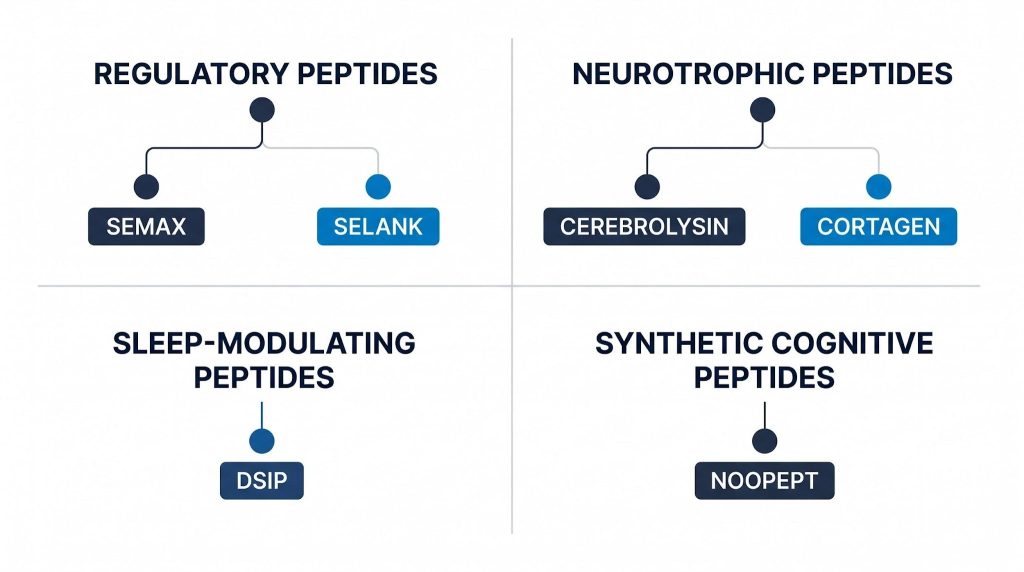
Nootropic peptides break into four research groups. Regulatory peptides such as Semax and Selank shift neurotransmitter signaling. Neurotrophic peptides such as Cerebrolysin and Cortagen are studied for neuron survival in research models. Sleep peptides such as DSIP affect circadian and arousal pathways. Synthetic cognitive peptides such as Noopept are designed for stability and absorption. Each group has its own research focus.
The category matters when matching a peptide to a research question. A study looking at anxiety-like markers tends to pick a regulatory peptide such as Selank. A neurodegeneration model often uses a neurotrophic preparation such as Cerebrolysin. The four-group split also tracks how pharmacology textbooks classify these compounds. It helps researchers map a candidate peptide to the right assay design and outcome measure for their work.
How Do Nootropic Peptides Work in Research Models?
Most research on nootropic peptides focuses on a few key pathways. The most-cited are BDNF (a growth factor linked to learning and memory), dopamine and serotonin signaling, GABA activity, and protection against neuron death. Each compound hits a different mix of pathways. According to a review in Molecules (2021), Semax and Selank have both been associated with higher BDNF expression in the rodent hippocampus.
Peptides behave differently than small-molecule nootropics. Where a small molecule usually hits one receptor, a preparation such as Cerebrolysin contains many active fragments studied for combined neurotrophic effects. That makes lot-to-lot reproducibility matter more for peptide work. Researchers running replication studies prioritize high-purity sourcing and batch-level COA documentation. Without that, the same compound name from two suppliers may give different research outcomes.
Browse the brain peptides catalog at Next Level Pharm for HPLC-verified Semax, Selank, Cerebrolysin, and more.
Which Nootropic Peptides Have the Most Research?
Three compounds dominate the published nootropic peptide research. Semax and Selank carry the largest rodent research base, with most studies coming from Russian academic centers. Cerebrolysin has the broadest clinical research base. According to ClinicalTrials.gov (2024), Cerebrolysin has appeared in trials for stroke recovery, traumatic brain injury, and Alzheimer disease research.
Publication count does not always match research quality. Semax has substantial work from one regional research community, but limited Western randomized trial data. Cerebrolysin has international Phase III clinical work, which gives it stronger translational evidence. Noopept and DSIP have smaller research bases but specific niches. Noopept is studied for memory retention models. DSIP is studied for sleep architecture. The choice between compounds depends on the research mechanism being studied, not just publication volume.
What Defines Research-Grade Quality?
Research-grade peptides are made and tested to standards that support reproducible lab work. That means three things. HPLC purity at 99 percent or above. Mass spec confirmation that the molecule matches the label. A Certificate of Analysis for every batch. Accordion often fails these basic identity and purity checks.
The quality chain matters because peptides degrade fast without proper handling. According to a study in Drug Testing and Analysis (2020), products from unverified suppliers frequently fail identity or purity confirmation. Lyophilized presentation and inert-atmosphere sealing protect the molecule through storage and transit. The lyophilized (freeze-dried) format is stable at room temperature during shipping and does not require refrigeration. A Certificate of Analysis ties each vial to its specific lot’s test results.
What Should I Check Before Sourcing a Nootropic Peptide?
Three checks separate research-grade supply from undocumented inventory. First, does the supplier publish the HPLC purity score on the Certificate of Analysis for each lot? Second, does that COA include independent mass spec confirmation of identity? Third, does the supplier ship lyophilized peptides – the freeze-dried format is stable at room temperature during transit and does not require refrigeration? Next Level Pharm publishes both HPLC and mass spec results on every COA, tied to the exact lot delivered.
It is also worth checking the documentation for synthesis date and lot number. These let you track potential degradation if a vial sits in storage. Reviewers may ask for the COA when assessing replication. Without traceable documentation, the same peptide name from two suppliers can produce different research results. That is why the verification chain of HPLC plus mass spec plus COA is the working definition of research-grade.
| Compound | Studied for | Most-cited research |
| Semax | Memory, dopamine, BDNF | Rodent cognition studies |
| Selank | Anxiety-like behavior, GABA, BDNF | Rodent anxiolytic models |
| Cerebrolysin | Neuroprotection, stroke recovery | International Phase III trials |
| Cortagen | Bioregulator, cognitive aging | Russian geroscience research |
| DSIP | Sleep architecture, delta waves | Sleep lab research |
| Noopept | Memory retention, anti-amnesia | Rodent memory studies |
Frequently Asked Questions
What are nootropic peptides?
Nootropic peptides are short amino-acid chains studied for effects on memory, focus, and brain protection in lab and clinical research. The group includes regulatory peptides such as Semax and Selank, neurotrophic preparations such as Cerebrolysin, and synthetic cognitive options such as Noopept. Each works on a different brain pathway. These are research compounds, not approved cognitive therapies, and the research framing matters when reading any study on them.
Which nootropic peptide has the most research?
Cerebrolysin has the most international clinical research. It has appeared in Phase III trials for stroke recovery and dementia research. Semax and Selank have the largest published rodent research base. The right compound depends on what brain pathway is being studied, not just total publication count. Researchers planning replication studies should match their compound choice to the specific mechanism in the available literature.
How do Semax and Selank differ?
Both come from the same Russian peptide research program at the St. Petersburg Institute. Semax research focuses on dopamine and BDNF, with cognitive and stress-recovery endpoints. Selank research focuses on GABA and serotonin, with anxiety-related models in rodent studies. Both compounds have been associated with raised BDNF in published rodent work. Researchers pick between them by matching the compound to the specific brain pathway being studied in their experimental design.
What does Cerebrolysin contain?
Cerebrolysin is a complex peptide preparation made from porcine brain tissue. It contains low-molecular-weight peptide fragments and free amino acids. The mix has been studied for neurotrophic effects in cell culture and animal models. Clinical research has examined it for stroke recovery, traumatic brain injury, and Alzheimer disease in international trials. It is approved as a drug in some non-US markets but remains research use only in the US.
Is research-grade Semax different from generic Semax?
Yes. Research-grade Semax means HPLC purity at 99 percent or above, with mass spec identity confirmation and a Certificate of Analysis for every batch. Independent studies have flagged identity and purity problems in peptides from unverified suppliers. The HPLC score and mass spec result should appear on every COA. Documentation is what makes research outcomes comparable between labs and across replication studies.
Are nootropic peptides FDA approved?
None of the major nootropic peptides has FDA approval as a therapeutic drug for cognition or wellness applications in the US. They are sold for research use only. Cerebrolysin is approved as a drug in some non-US markets but not the US. The compounds remain research peptides, and any inference about clinical applications has to account for the gap between preclinical findings and regulatory approval.
How is peptide purity verified?
Purity is checked with high-performance liquid chromatography, or HPLC, which separates the target peptide from impurities. It measures the percentage of the prep that is the correct molecule. Mass spec confirms that the molecular weight matches the label. Together, these two methods are the standard analytical chain for research-grade peptides. Both results appear on the Certificate of Analysis for each lot delivered.
Why does so much peptide research come from Russia?
Semax, Selank, Cortagen, and Epithalon were developed at the St. Petersburg Institute of Bioregulation and Gerontology and related Russian research centers. The work is real and published, but the regional concentration means there is less Western replication data than for many other compounds. That matters when designing replication studies. Western indexed clinical trials are smaller in number, even though the preclinical base is substantial.
Summary
Nootropic peptides are short amino-acid chains studied for effects on memory, focus, and brain protection. The main groups are regulatory peptides such as Semax and Selank, neurotrophic preparations such as Cerebrolysin, sleep peptides such as DSIP, and synthetic cognitive compounds such as Noopept.
Most research targets BDNF expression, dopamine signaling, GABA pathways, or sleep architecture. Cerebrolysin has the broadest international clinical data. Semax and Selank have the largest rodent research base. Each compound has its own research focus and is not interchangeable.
Research-grade sourcing requires HPLC purity above 99 percent, mass spec confirmation, and a Certificate of Analysis on every batch. Without that documentation chain, study results are not replicable. The COA is the practical gate for any serious research peptide purchase.
What Should You Do Next?
If you are working with nootropic peptides for research, here is where to start:
- Pick the compound that matches the pathway you are studying. Semax is the choice for dopamine and BDNF work, Selank for GABA and anxiety-related models, and Cerebrolysin for neurotrophic research.
- Ask for the Certificate of Analysis with the HPLC purity score and mass spec confirmation. Every batch should ship with both.
- Check that the supplier ships lyophilized peptides – the freeze-dried format is stable at room temperature in transit and does not require refrigeration.
Browse the brain peptide catalog for research-grade options shipped with full documentation.
Related research: Semax research, Selank research, and brain peptides compared.
People Also Read
About the Author
Next Level Pharm Research Team
Alex M covers peer-reviewed findings in peptide science for Next Level Pharm, a US-based supplier of research-grade peptides verified to ≥99% purity via HPLC and mass spectrometry on every batch.
Disclaimer: The information provided on this page is for educational and research purposes only. Next Level Pharm’s products are intended for laboratory research use only. They are not intended for human consumption, diagnostic, therapeutic, or medicinal purposes. This content does not constitute medical advice. Always consult a licensed healthcare professional before making any health-related decisions.